

There are performances people applaud, and then there are performances people feel long after the music ends. On a stage as familiar and celebrated as American Idol, where big voices and dramatic moments arrive every season, it can be difficult to create something that genuinely stops time. Audiences have seen tears, standing ovations, and unforgettable runs of talent. They know what excellence looks like. They know when they are impressed. But every once in a while, someone steps forward and creates something deeper than applause.

That night, Hannah Harper did exactly that.
The choice of song mattered immediately. Landslide is not the kind of track a singer can hide behind. It offers no fireworks, no built-in spectacle, no easy place to mask uncertainty with volume. It asks for honesty. It asks for emotional maturity. It asks the performer to stand inside the meaning of every line and trust that truth will be enough. Many sing it. Few truly inhabit it.
From her first note, the room sensed something different. There was no attempt to overpower the melody or turn the moment into a display of technical excess. Instead, she sang with restraint, and that restraint became magnetic. It felt less like someone performing for an audience and more like someone opening a private page of her life in front of strangers. When that kind of vulnerability is real, it changes the temperature of a room.
The judges noticed it almost instantly. Conversation stopped. Expressions changed. The instinct to react disappeared because reaction would have interrupted what was unfolding. Sometimes silence from a judging panel says more than praise ever could. It means they understand they are witnessing something that needs no commentary in the middle of it. It means the moment belongs entirely to the artist.
The audience responded in the same way. The usual energy of a live taping—movement, whispers, anticipation—seemed to dissolve. People leaned forward instead of back. Faces softened. Some watched with wide eyes, others with the distant expression people wear when a song unexpectedly reaches into memory. That is the rare power of a deeply felt performance: it does not merely entertain; it awakens something personal inside the listener.
What made Hannah Harper so compelling was not only the sound of her voice, but the emotional intelligence behind it. She knew when to hold back, when to let a line breathe, when to allow a pause to say what words could not. Many singers chase the biggest note of the night. She chased the truest feeling of the night—and that is far harder to achieve.
As the final chorus approached, tension built in the most unusual way. Not through noise or explosive arrangement, but through stillness. The room seemed to know something meaningful was about to conclude, and no one wanted it to end too quickly. When the last note arrived, it landed softly—but with the force of something unforgettable. Then came that beautiful split second after true artistry, when no one moves because everyone is still inside it.
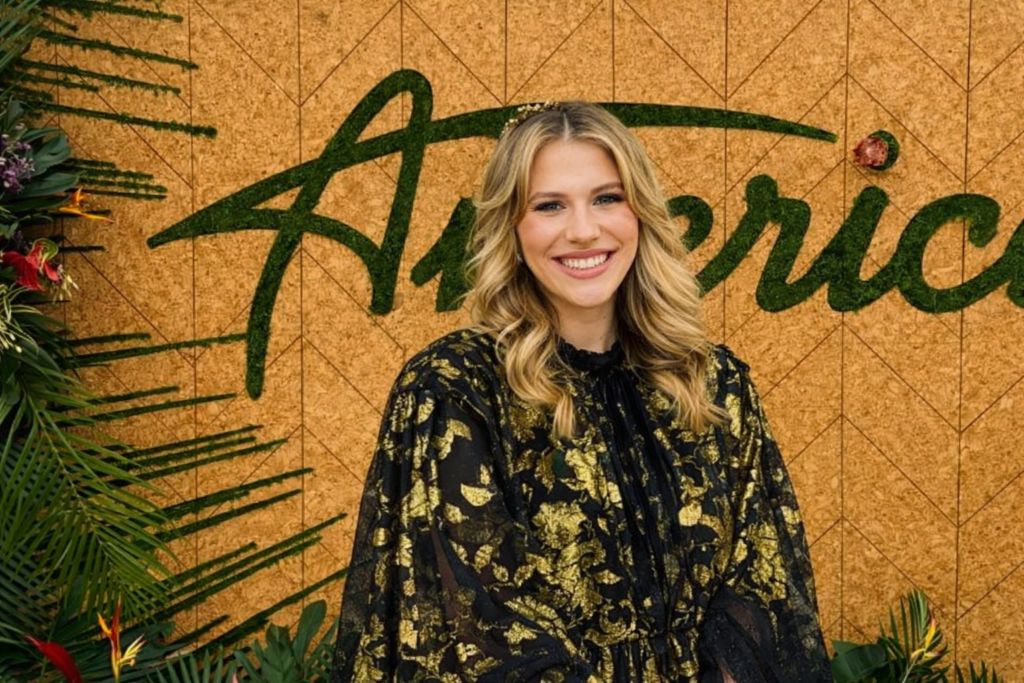
And then, just when the spell felt complete, the unexpected happened. Carrie Underwood did something no one in the room saw coming. Gasps spread through the crowd. Expressions shifted from emotional stillness to pure shock. The atmosphere transformed in an instant. A moment that already felt memorable suddenly became historic.
What mattered most was not the surprise itself, but what it signified. Carrie Underwood knows better than most what that stage can mean. She understands the pressure, the scrutiny, the hunger, and the fragile hope contestants carry into every performance. For someone with that legacy to break expectation in response to Hannah Harper’s moment suggested something powerful: excellence recognizes excellence.
The crowd’s reaction was immediate because people understand symbolism even before it is explained. When a respected figure interrupts the expected rhythm of a show to acknowledge someone, it tells the room that this was not ordinary television. This was not just another contestant singing another song. This was a performer crossing into a different category—the kind remembered beyond the episode itself.
Hannah Harper’s greatest achievement that night may have been this: she made everyone forget the machinery of competition. For a few minutes, there were no rankings, no rounds, no strategies, no predictions. There was only music, honesty, and the shared silence of people moved at the same time. That is incredibly difficult in any setting, and even rarer under the bright pressure of a televised stage.
Long after louder performances are forgotten, these are the moments that endure. Not because they were flashy, but because they were human. Not because they shocked, but because they connected. The best performances do not demand attention—they earn emotion. They leave people quieter than they were before they began.
That night, Hannah Harper did more than sing “Landslide.” She turned it into a mirror for everyone listening. And when Carrie Underwood responded in a way no one expected, it confirmed what the room had already begun to realize: they had not just watched a contestant perform. They had watched an artist arrive.