
There are episodes in talent competitions that entertain, and then there are episodes that quietly rearrange everything people thought they knew. Rock Night on American Idol was expected to be a test of force—big vocals, dramatic risks, and the kind of high-voltage performances designed to dominate the room. It was supposed to reward volume, swagger, and fearless excess.
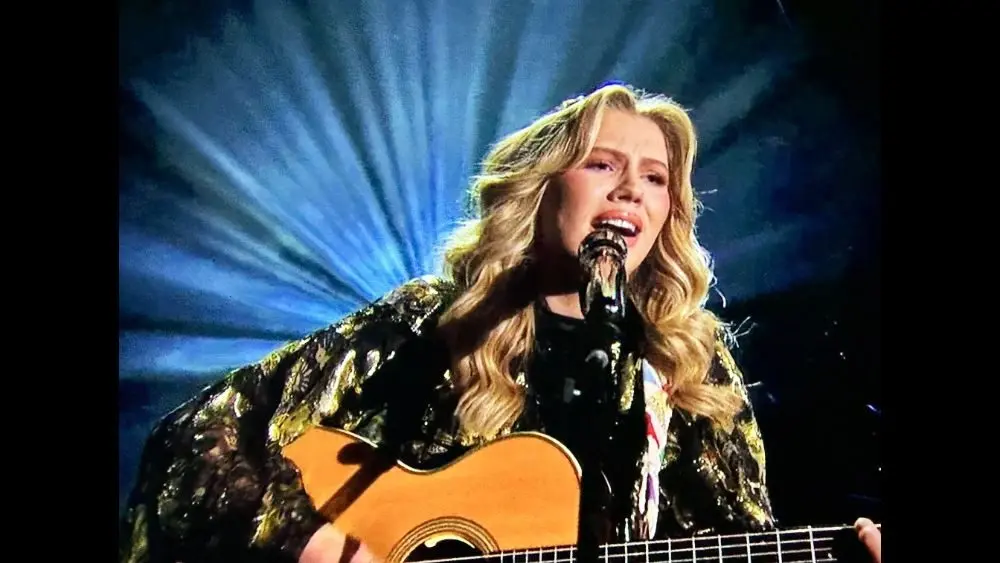
Instead, Hannah Harper transformed it into something far more dangerous: truth.
When she stepped into the spotlight, many expected the usual challenge contestants face on themed nights—the pressure to fit the assignment rather than reveal themselves through it. Theme weeks can be traps. They often encourage imitation over identity, spectacle over sincerity. Contestants chase what the night is supposed to sound like and lose what made them unique in the first place.
Hannah Harper chose the opposite path.
Rather than trying to out-rock the room, she brought something more compelling than noise. She carried raw strength, emotional honesty, and the kind of control that does not need to announce itself. While others may have treated the moment like a competition, she treated it like a confession. That difference changed everything.
Her song choice, Landslide, became the perfect vehicle for that decision. It is not a song that rewards empty dramatics. It asks for perspective. It asks for vulnerability. It asks the performer to stand inside memory, change, fear, and resilience all at once. Singers can perform it technically and still miss its soul. Hannah did not miss it. She stepped directly into the emotional center of it.
From the opening lines, the room seemed to understand it was witnessing something different. There was no frantic attempt to impress. No desperate reaching for applause. No oversized gestures designed for television clips. Instead, every phrase felt lived-in. Every note sounded connected to something real. She was not simply singing lyrics—she was translating experience into sound.
That kind of performance affects audiences in a way flashy moments often cannot. Flash can shock. Power can thrill. But honesty lingers. Honesty makes people stop moving. It makes them think of their own lives while watching someone else’s story unfold. It turns strangers into participants because everyone recognizes sincerity when it appears.
As the performance continued, social media reacted exactly as it does when something authentic breaks through the noise. Fans flooded timelines with disbelief, praise, and emotional reactions. Some focused on her vocal control. Others described chills, tears, or the feeling that they had just watched a contestant become an artist in real time. Many said the same thing in different words: she had just changed the season.
That reaction was not only about talent. It was about timing. Every competition reaches a point where audiences stop asking who is good and start asking who matters. Many contestants can sing beautifully. Fewer can create a moment that feels larger than the show itself. Hannah Harper seemed to cross that line during Rock Night.

What made it even more striking was the contrast of the theme itself. Rock Night often rewards aggression, edge, and obvious dominance. Hannah found another route to command. She used restraint where others might use force. She used depth where others might use volume. She proved that strength is not always loud—and sometimes the calmest performer can leave the deepest mark.
By the final note, there was a sense in the room that something had shifted. Not dramatically, not through manufactured suspense, but through collective recognition. The audience knew they had not simply watched a solid performance. They had watched a contestant redefine expectations in the middle of a high-pressure stage.
That is how races change. Not always through rankings or judge comments, but through momentum. Through the moment viewers begin imagining someone at the finish line. Through the instant a performer stops seeming like one of many and starts feeling inevitable. Hannah Harper’s Rock Night performance carried exactly that energy.
The most successful contestants understand that winning hearts is often more important than winning rounds. Technical excellence can earn respect. Emotional connection earns loyalty. And loyalty is what carries artists through the unpredictable tides of public voting, weekly themes, and shifting narratives. Hannah did not just gain applause that night—she may have gained belief.
Long after louder performances fade, people remember the ones that felt personal. They remember the contestant who made a famous song sound newly vulnerable. They remember the artist who ignored the pressure to conform and trusted sincerity instead. They remember the night when a challenge became a breakthrough.
Rock Night was supposed to test Hannah Harper. Instead, she used it to reveal who she might truly be in this competition: not just a contender, but a frontrunner rising at exactly the right time.