

Every season of American Idol reaches a moment when casual viewers become believers. It is the point where a contestant stops feeling like a promising name in the lineup and starts looking like someone built for the finale. Rankings begin to shift, narratives change, and audiences suddenly ask a different question: not can they survive another round? but how far can they really go?
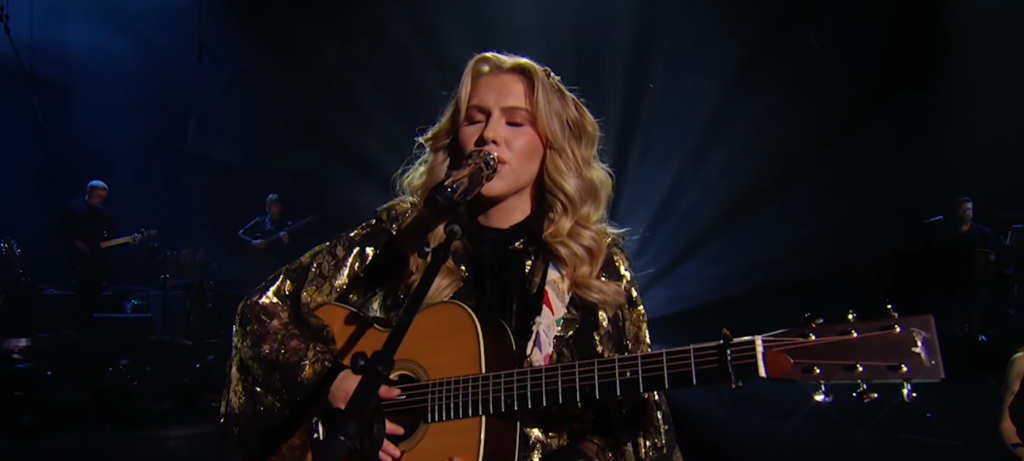
For Hannah Harper, that moment may have arrived in unforgettable fashion.
Long before the national stage, Hannah was already building momentum through viral country covers that introduced audiences to her natural tone, sincerity, and unmistakable identity. In a digital world full of polished imitations and trend-chasing performances, she stood out for a simpler reason—she sounded genuine. Viewers did not just hear talent; they heard someone who knew exactly where she came from.
That foundation matters more than many realize. Talent competitions reward strong voices, but long-term fan support often belongs to artists with roots people can feel. Hannah Harper has consistently carried that advantage. She does not perform like someone searching for a persona. She performs like someone already living inside one.
Then came the latest episode, where she took on At The Cross (Love Ran Red). It was a bold choice, not because of technical difficulty alone, but because songs built on faith and emotional vulnerability demand far more than clean notes. They require conviction. They require trust. They require the ability to make deeply personal themes feel universal without overplaying them.
Many singers approach songs like this with caution, afraid to do too much or too little. Hannah approached it with maturity. She seemed to understand that the performance did not need to be louder than the room—it needed to be truer than it. From the opening lines, there was a calm confidence in the way she delivered each phrase. No forced drama. No theatrical excess. Just clarity, emotion, and purpose.
That restraint made the performance stronger. Instead of chasing applause, she invited reflection. Instead of trying to impress, she chose to connect. Those choices often separate memorable contestants from temporary ones. Anyone can have a big moment. Far fewer know how to create a meaningful one.
Industry watchers and longtime viewers often notice the same thing when a contestant is ready for the final stretch: emotional control. Not just control of pitch or phrasing, but control of atmosphere. Hannah demonstrated exactly that. She seemed to slow the room down, drawing attention inward rather than outward. It is a rare skill to make a live television audience feel quieter than before you began.
The response reflected it immediately. Fans praised the honesty of the performance, while others pointed to her consistency across genres and themed nights. Some contestants rise because of one explosive episode and fade the next week. Hannah’s momentum feels different because it is built on steady growth. Each round appears to reveal more depth rather than more desperation.

That growth is one of the strongest arguments for her Top 3 potential. Finalists are rarely chosen by talent alone. They are chosen by momentum, identity, adaptability, and the sense that viewers are watching someone evolve in real time. Hannah Harper checks each box. She entered as a strong vocalist, but she now looks increasingly like an artist audiences want to follow beyond the show.
Another reason she feels dangerous in the competition is authenticity. Viewers are highly sensitive to contestants who shift personas weekly in search of votes. Hannah has done the opposite. Whether performing country-rooted material, emotional ballads, or spiritually resonant songs, she remains recognizably herself. That consistency builds trust—and trust turns into votes.
There is also strategic strength in staying true to her roots. Artists who understand their lane often outperform technically stronger singers who still seem undefined. Hannah’s identity gives every song context. When she sings, it does not feel random. It feels connected to who she is. That creates a clearer emotional relationship with the audience week after week.
Of course, no season is simple. American Idol is filled with gifted performers, shifting fan bases, and unpredictable weekly themes. One stunning night does not guarantee a finale spot. Competition history is full of contestants who peaked early or were upset unexpectedly. The path ahead remains demanding.
But there are moments when a contestant begins to feel inevitable, and Hannah Harper may be approaching that territory. She has the voice to compete, the story to resonate, the humility to remain likable, and the artistic instincts to keep surprising people without losing herself. That combination is powerful late in a season.
If she continues on this trajectory, the Top 3 conversation may soon feel outdated. The real discussion could become whether anyone can stop her momentum before finale night. Because when a contestant can move viewers without abandoning who they are, they become more than a hopeful—they become a threat.
So, is Hannah Harper officially a Top 3 finalist? Nothing is official until votes are counted. But after a performance like this, the question no longer sounds ambitious. It sounds realistic.