
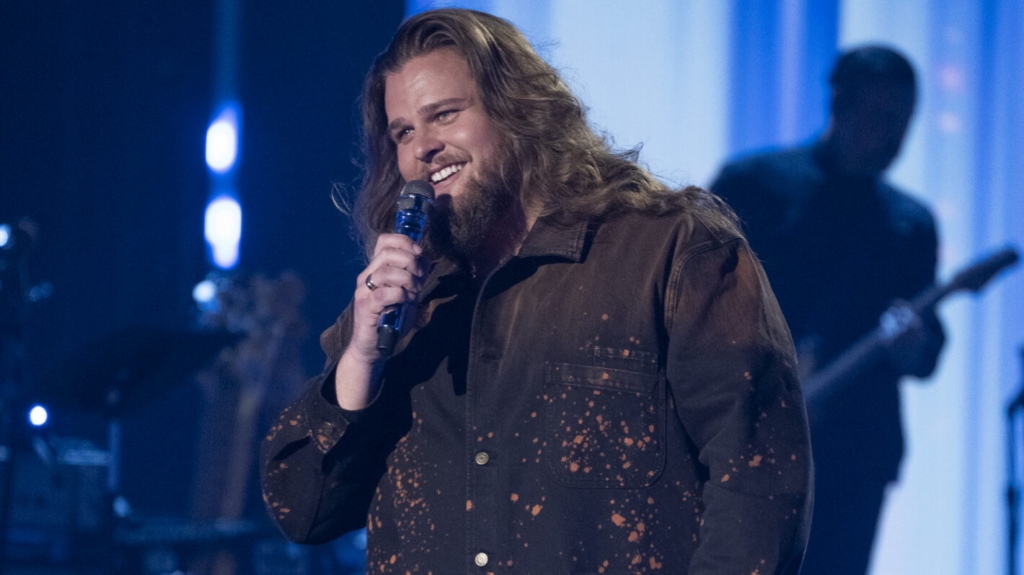
There are moments on television that entertain, and then there are moments that transcend the screen entirely. Chris Tungseth gave the world the latter. On the stage of American Idol, under lights that have witnessed countless dreams, his story unfolded not as a performance—but as a revelation.

Before the applause, before the cameras, before the Top 5 announcement, there was a man who worked with his hands. A construction worker. Someone who built structures others would live in, long before he realized he could build something far greater—belief in himself.
And that’s what made this moment different.
Because when Chris stood there singing those final notes, it wasn’t just about pitch or tone. It was about everything that led him there. The early mornings. The long shifts. The quiet dreams carried between the noise of machines and the weight of expectation. Dreams that, for many, remain unspoken.
But not for him.
The studio, once buzzing with anticipation, fell into a silence so profound it felt almost sacred. It wasn’t forced—it was felt. The kind of silence that only happens when people collectively realize they are witnessing something real.
And then came the announcement.
Top 5.
A milestone for any contestant, but for Chris, it carried something deeper. It wasn’t just progression in a competition—it was a breakthrough. A moment that stretched beyond personal success and touched something communal. Something rooted in identity, pride, and place.
Because back in Minnesota, this wasn’t just his victory.
It was theirs.
An entire small town had gathered, not just watching from afar, but showing up in the most tangible way possible. Buses filled with people who knew him, believed in him, and carried pieces of his story within their own. They didn’t come to witness a performance. They came to stand beside a dream.
And when Chris looked up and said, “I’m doing this for everyone,” it wasn’t a line.
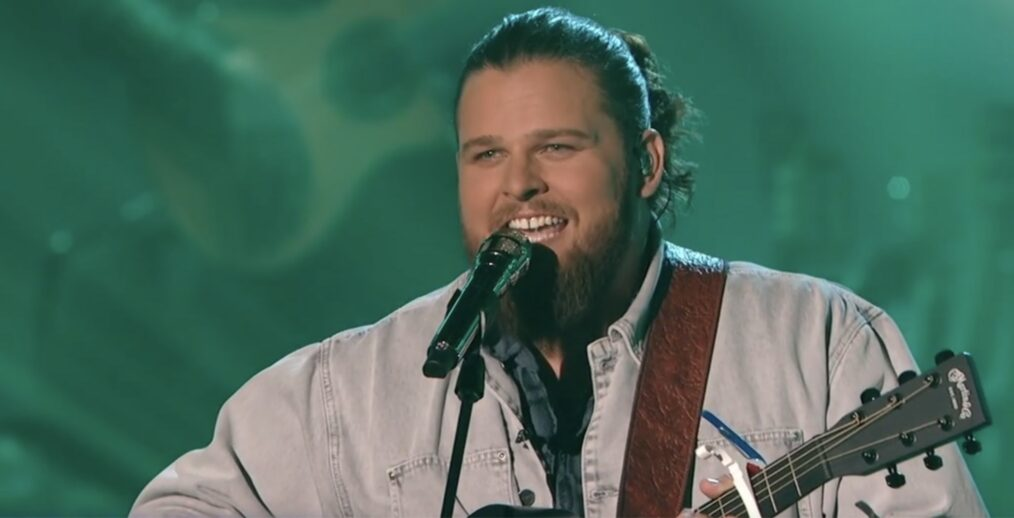
It was a truth.
A simple sentence that carried the weight of countless untold stories. Of workers who never get the spotlight. Of communities that often feel unseen. Of people who dare to believe quietly, hoping one day their moment might come.
In that instant, something shifted.
The dream was no longer his alone.
It belonged to every person who had ever felt overlooked, underestimated, or confined by circumstance. It belonged to every individual who has stood in a place that didn’t seem connected to possibility—and imagined more anyway.
That’s why people cried.
Not because it was dramatic, but because it was honest. Because it reflected something deeply human—the desire to rise, to be seen, to matter. And Chris Tungseth, without trying to be anything other than himself, became a mirror for that desire.
What makes his journey so powerful isn’t just where he is now, but where he started. The contrast between construction sites and concert stages isn’t just physical—it’s symbolic. It represents the distance between limitation and possibility.
And yet, he bridged it.
Not overnight. Not by accident. But through persistence, courage, and a belief that refused to fade, even when the path ahead wasn’t clear.
As the competition moves forward, the stakes will rise. The performances will grow bigger. The pressure will intensify. But Chris carries something that can’t be taught or rehearsed.
He carries purpose.
And purpose, when paired with talent, becomes something unstoppable.
This wasn’t just a Top 5 moment.
It was a reminder.
That dreams don’t belong to a certain kind of person. They don’t require a perfect starting point. They don’t wait for permission. Sometimes, they grow in the most unexpected places—between steel beams and concrete floors, in quiet towns, in ordinary lives.
Until one day, they step into the spotlight.
And when they do, the world doesn’t just watch.
It feels.