
There are moments on American Idol that entertain… and then there are moments that settle into people. Not loudly, not instantly—but deeply. The kind that lingers long after the final note fades, the kind that doesn’t ask for applause because it already has something far more powerful: attention held in complete stillness.
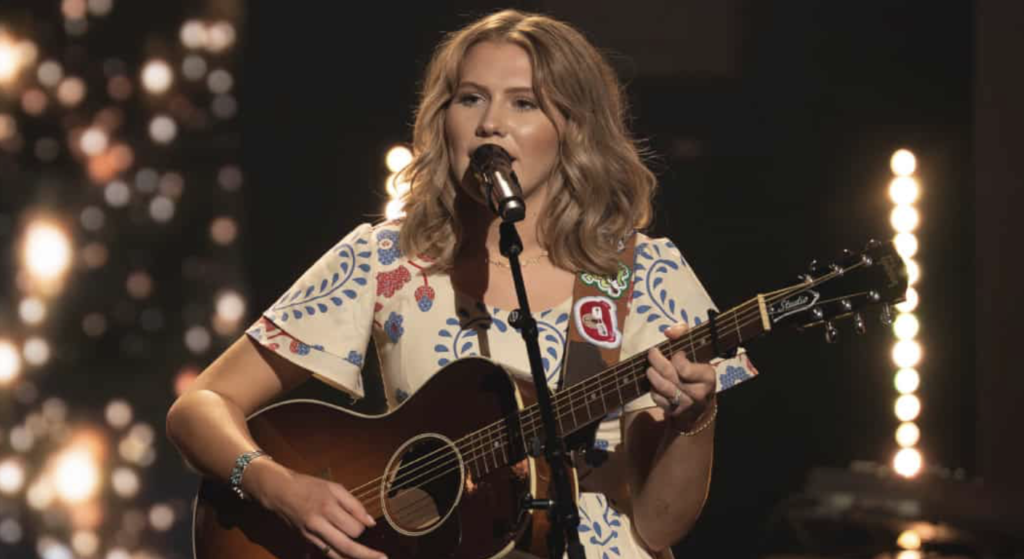
That’s exactly what happened when Hannah Harper stepped into “Choosin’ Texas.”
There was no rush to impress. No visible attempt to outshine. From the very first note, what unfolded felt intentional—almost restrained. But within that restraint was something quietly overwhelming. Her voice didn’t arrive to perform the song… it arrived to live inside it.
And that changed everything.
Because this wasn’t a performance built on precision—it was built on presence. Every lyric felt placed, not sung. Every pause felt meaningful, not accidental. It was as if Hannah wasn’t trying to reach the audience… she was allowing the audience to come to her.
And they did.
The room, both physical and virtual, seemed to fall into sync with her pacing. You could sense it—the shift from watching to listening, from listening to feeling. These are the moments artists spend years chasing, where connection replaces effort and authenticity replaces expectation.
By the time she reached the emotional core of the song, it no longer felt like “Choosin’ Texas” as it was written.
It felt like her story.
And that’s where the performance crossed a line few ever reach—it stopped being a cover.
It became ownership.
Even Ella Langley, the very artist behind the song, couldn’t hide her reaction. There’s a certain unspoken tension when an original artist hears their work reinterpreted. It can feel protective, even cautious. But what Ella expressed wasn’t hesitation—it was recognition.
Recognition that something rare had just happened.
Because honoring a song is one thing. Becoming part of its identity is another.
And Hannah did both.
What makes this moment so compelling isn’t just the praise—it’s the consistency of it. Fans aren’t using scattered words or surface-level reactions. They’re speaking with clarity. With conviction. Phrases like “most powerful of the season” aren’t being thrown around lightly—they’re being repeated, reinforced, and believed.
That kind of reaction doesn’t come from spectacle.
It comes from truth.
And truth, when it lands, doesn’t need amplification.
It spreads quietly.
For weeks now, Hannah Harper has been navigating the competition with a kind of steadiness that almost goes unnoticed at first glance. She doesn’t chase moments—she builds them. Slowly, carefully, without forcing attention. And because of that, when a moment like this arrives, it feels earned.
It feels inevitable.
There’s something deeply human about the way she approaches music. A grounded quality that reflects where she comes from—her roots in gospel, bluegrass, and storytelling traditions that prioritize emotion over perfection. She doesn’t separate herself from the song. She allows herself to be shaped by it.
And audiences feel that.
Because in a space where so many are trying to be unforgettable, Hannah is simply being real.
And somehow, that’s what makes her unforgettable.
But here’s where it becomes even more intriguing.
Because when a performance resonates this strongly, it doesn’t just elevate a contestant—it shifts the entire landscape around them. Expectations rise. Conversations sharpen. And suddenly, what once felt like a journey becomes something else entirely.
A possibility.
Fans aren’t just reacting anymore—they’re anticipating. Watching closely. Listening differently. Waiting for what comes next with a kind of emotional investment that can’t be manufactured.
And that’s where the real pressure begins.
Because moments like this don’t exist in isolation.
They echo forward.
The question now isn’t whether Hannah Harper delivered something special.
That part feels undeniable.
The real question is what happens when a single performance starts redefining how people see you… when one song becomes a reference point, a standard, a quiet promise of what you might be capable of next.
Because when a room stops for you once—
Everyone wonders if you can make it happen again.
And somewhere, just beyond the applause and the praise, that question is already waiting.