
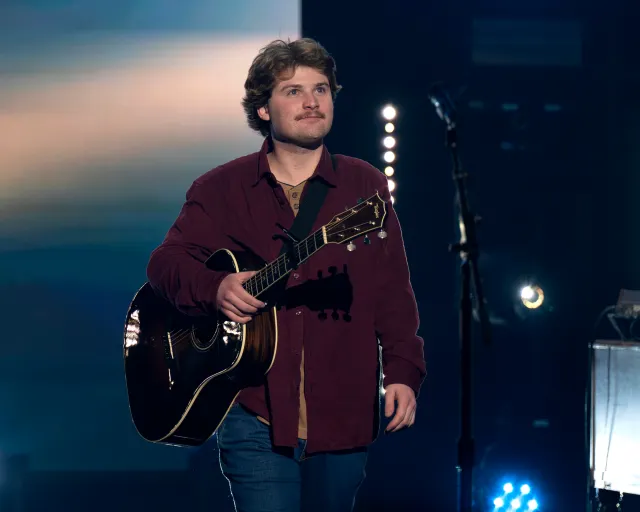
There are song choices that feel safe, almost predictable, and then there are those that quietly carry risk beneath their surface. When Lionel Richie handed Brooks Rosser the delicate task of performing Linger on American Idol, it wasn’t just a selection—it was a test disguised as a suggestion.

Because “Linger” is not a song that rewards force.
It doesn’t respond to power or vocal display. Instead, it lives in restraint, in softness, in the kind of emotional patience that many performers struggle to maintain under pressure. Originally shaped by the haunting voice of Dolores O’Riordan, the song carries a fragile balance—too much control and it feels distant, too much emotion and it collapses under its own weight.
And that is where Brooks found himself standing.
At the edge of something that could either elevate him or quietly expose him.
From the very first note, however, there was a shift—subtle, but unmistakable. Brooks didn’t approach the song like a challenge to conquer. He approached it like a moment to understand. There was no rush, no urgency to prove himself. Instead, he allowed the song to unfold at its own pace, trusting that its quiet strength would carry him if he simply stayed honest within it.
That decision changed everything.
His tone, gentle but grounded, created an atmosphere that felt almost suspended in time. It wasn’t about commanding attention—it was about holding it without asking. The kind of presence that doesn’t need to be announced, because it is already felt.
And in a competition built on big voices and bigger moments, that kind of stillness becomes its own form of power.

What made Brooks’ performance particularly compelling was his control—not just technically, but emotionally. He didn’t overreach. He didn’t try to reinvent the song into something louder or more dramatic. Instead, he respected its structure while subtly reshaping its feeling.
He made it his, without forcing it to be.
There is a difference between singing a song and living inside it, and Brooks chose the latter. You could hear it in the way he lingered on certain phrases, allowing them to breathe just a second longer than expected. You could feel it in the spaces between notes, where silence carried as much weight as sound.
That kind of awareness cannot be taught overnight.
It comes from an understanding that music is not just about what you deliver, but what you allow the audience to discover. Brooks didn’t give everything at once. He let the performance reveal itself slowly, inviting listeners to lean in rather than sit back.
And that invitation was accepted.
By the time the song reached its emotional peak, there was no need for a dramatic shift or a sudden explosion of sound. The impact had already been built, layer by layer, through restraint and intention. It didn’t hit all at once—it settled, deeply and quietly, leaving a lasting impression rather than a fleeting reaction.
Lionel Richie’s reaction said more than words could.
Because when a judge who understands music at its core becomes visibly moved, it signals something beyond technical success. It signals connection. It signals that what just happened wasn’t just a performance—it was a moment that resonated on a deeper level.
And that is what separates contestants from artists.
Brooks Rosser, in this performance, didn’t just meet the challenge. He redefined it. What was meant to test his limits became an opportunity to reveal his instincts. And those instincts—rooted in patience, subtlety, and emotional clarity—are what give his artistry a sense of longevity.
There is also something quietly strategic about this moment.
At a stage in the competition where many contestants feel the pressure to escalate—to sing louder, to perform bigger, to stand out through sheer force—Brooks chose the opposite. He stepped back. He trusted that intimacy could compete with intensity.

And in doing so, he carved out a space that felt entirely his own.
Because originality doesn’t always come from doing more.
Sometimes, it comes from doing less, but meaning it more.
The question now isn’t whether Brooks can deliver a strong performance. He has already answered that. The question is how far this kind of artistry can carry him in a competition that often rewards immediacy over subtlety.
But if this performance proved anything, it’s that moments like this don’t fade easily.
They linger.
And Brooks Rosser, with nothing but control, emotion, and a quiet understanding of what the song needed, didn’t just perform “Linger.”
He became the reason it will be remembered.