
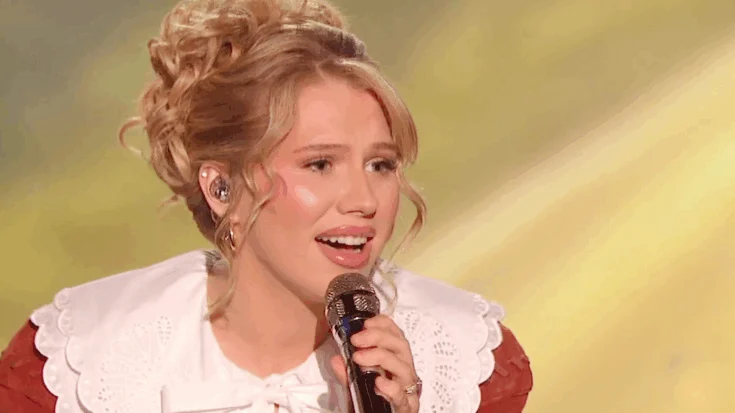
Progress on American Idol is rarely loud. It doesn’t always come with viral moments or dramatic shifts. Sometimes, it arrives quietly—week by week, performance by performance—until one day, you realize a contestant hasn’t just survived the competition… they’ve settled into it. That’s where Hannah Harper stands right now.

But tonight changes everything.
Because reaching this stage is no longer about proving potential. It’s about confirming presence. The Top 10 isn’t just another milestone—it’s a filter. One that separates those who are still being evaluated from those who have already been chosen by the audience, even if unofficially.
And Hannah’s journey has been built differently.
She hasn’t relied on spikes of attention. No sudden viral surge, no overwhelming moment that forced people to notice her. Instead, she’s taken a slower route—one that builds familiarity. And familiarity, in a public voting competition, is a quiet kind of power.
It doesn’t scream.
It stays.
Each of her performances has felt less like a reset and more like a continuation. There’s a consistency in her delivery that doesn’t demand attention but earns it. And over time, that creates something more valuable than a standout moment—it creates recognition.
But recognition alone isn’t enough anymore.
Because as the competition narrows, the expectations rise—not just from judges, but from the audience. Viewers begin to look for definition. They want to understand not just what a contestant can do, but who they are when they do it. And this is where many contestants begin to struggle.
They try to expand too quickly.
They reach for bigger notes, louder arrangements, more dramatic interpretations. In doing so, they risk losing the very thing that made people connect with them in the first place. It becomes less about authenticity and more about adaptation.
Hannah’s challenge tonight sits right at that edge.
Does she stay within the identity she’s built, or does she attempt to stretch beyond it to match the scale of the moment?
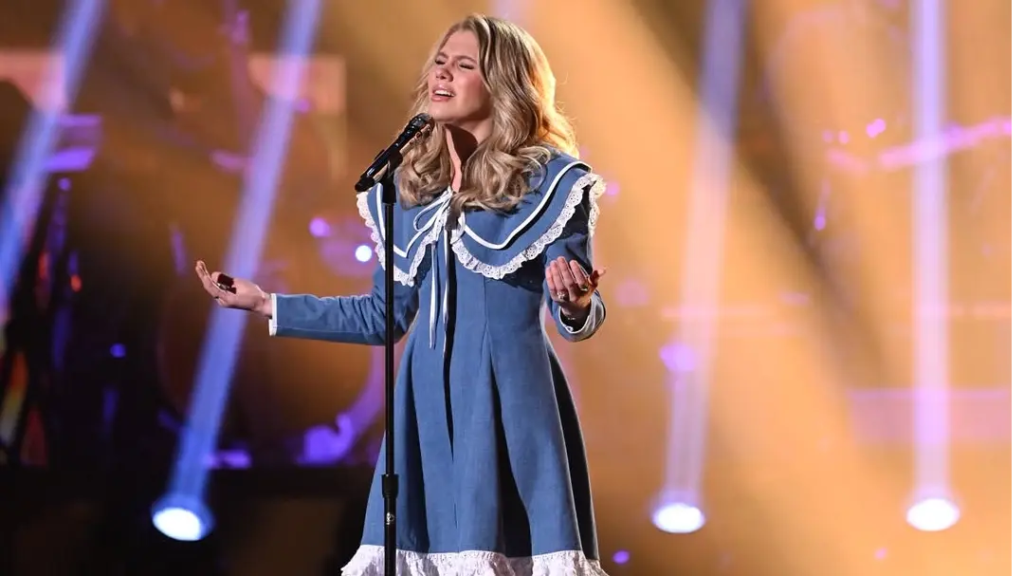
Because both paths carry risk.
Staying the same can feel safe—but at this level, safe can sometimes be mistaken for stagnant. On the other hand, changing too much can break the emotional continuity that her audience has been following. And at the Top 11 stage, continuity is everything.
It’s what turns viewers into voters.
That’s the shift most people don’t see happening.
Earlier in the competition, audiences judge performances individually. They compare contestants, analyze vocals, and react in the moment. But now, that behavior evolves. Voting becomes less about comparison and more about protection. People begin to support the contestant they feel invested in, not just the one who impressed them that night.
And Hannah has been building that investment carefully.
Her performances don’t feel like attempts to win—they feel like extensions of who she already is. There’s a grounded quality to her stage presence, a sense that she isn’t chasing the moment, but allowing it to unfold naturally. That kind of restraint, especially in a high-pressure environment, can be more powerful than any vocal peak.
Because it feels real.
And real is what people remember when the show ends.
But memory alone doesn’t secure a place in the Top 10.
Votes do.
This is where the pressure shifts away from the stage and onto the audience. Hannah’s progression so far suggests she has built a steady base—viewers who recognize her, trust her, and expect something consistent from her. But the question now is whether that base is active.
Because passive support doesn’t translate into results.
At this stage, every remaining contestant has talent. The difference comes down to whose audience shows up when it matters. And showing up doesn’t mean watching. It means acting. It means voting with intention, not assumption.
Tonight, Hannah doesn’t need to deliver the biggest performance of the night.
She needs to deliver the most lasting one.
Something that doesn’t fade once the next contestant steps on stage. Something that stays in the mind just long enough to turn into a vote. That’s the subtle game being played now—not volume, not spectacle, but memory.
And if she understands that balance—if she stays rooted while still giving the audience something to hold onto—then her performance won’t just be another entry in the night’s lineup.
It will be a continuation of a story people aren’t ready to see end.
Because in the end, advancing to the Top 10 isn’t about being the best performer in the room.
It’s about being the one the audience refuses to leave behind.