

There’s a certain kind of contestant that reality television trains us to expect — the loud entrance, the viral note, the moment engineered for instant applause. Shows like American Idol have long rewarded spectacle, the kind that demands attention rather than earns it. And yet, every season, there’s always one presence that quietly disrupts that pattern. This time, that presence feels unmistakably like Hannah Harper.
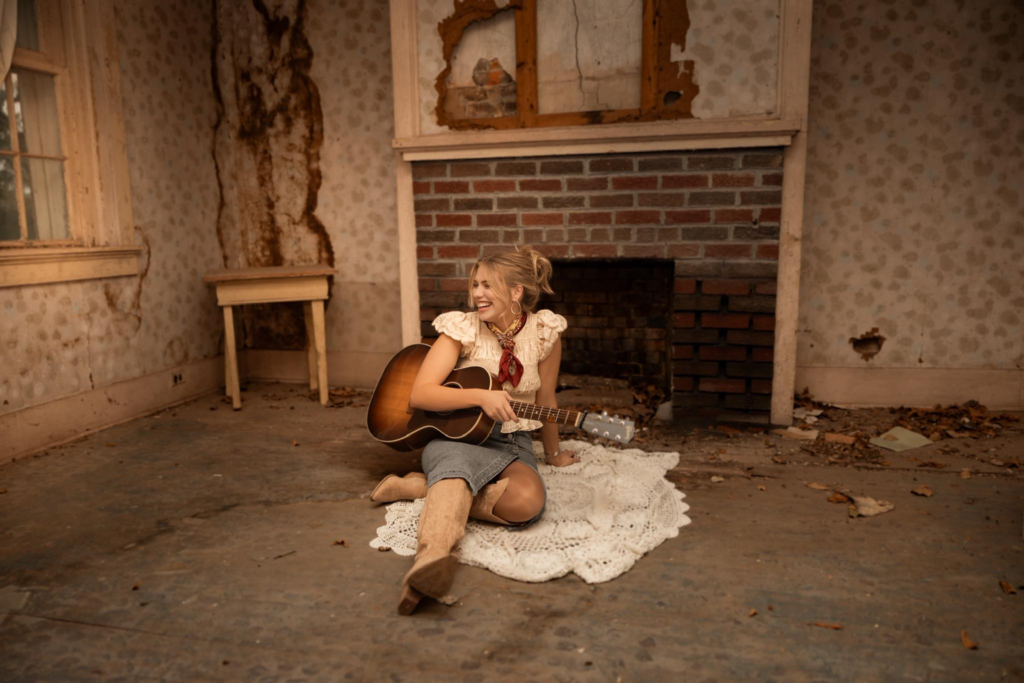
She doesn’t arrive like a storm. She doesn’t chase the room. She doesn’t compete for volume. And still, week after week, she remains.
At first glance, it feels almost confusing. In a competition designed for escalation — bigger vocals, sharper staging, louder reactions — Harper does something almost counterintuitive. She resists. Where others lean into transformation, she leans into stillness. Where others build spectacle, she builds space. And in that space, something unexpected happens: people start listening differently.
Because loudness is easy to notice, but it’s rarely what people remember.
Harper’s strength isn’t rooted in technical fireworks alone. It’s in restraint — a quality that, ironically, demands more control than excess ever could. When she sings, there’s no visible effort to impress. There’s no visible calculation. It feels less like a performance and more like a continuation of something that existed long before the stage lights turned on.
And that’s where the difference begins to show.
Audiences don’t just vote for voices. They vote for feelings they can’t quite explain. The kind that linger after the music stops. The kind that feels personal, even through a screen. Harper’s performances don’t ask for attention — they invite it. And that subtle shift changes everything about how people connect to her.
It’s not about who hits the highest note. It’s about who makes silence feel heavier.
In a season where many contestants are evolving rapidly — experimenting, shifting identities, chasing what might work — Harper’s consistency becomes its own form of unpredictability. You know what she’ll bring, but you don’t know how it will feel. And that emotional uncertainty keeps audiences leaning in, not out.

Because authenticity, when it’s real, doesn’t need reinvention to stay interesting.
There’s also something deeply psychological at play. Viewers often gravitate toward contestants who feel “safe” — not in a boring way, but in a grounding way. Harper doesn’t overwhelm. She steadies. In a competition filled with high-energy risks and volatile moments, she becomes a point of emotional return. And that creates loyalty — the kind that doesn’t fluctuate with trends.
Loyalty, unlike hype, doesn’t fade between episodes.
It builds quietly. Vote by vote. Week by week.
And perhaps that’s the part many overlook. Harper’s presence isn’t driven by viral spikes or headline moments. It’s sustained by something slower, deeper, and far more durable. While others chase attention, she accumulates trust. And in a voting system, trust is often more powerful than excitement.
Excitement fades. Trust stays.
Even her song choices reflect this philosophy. They don’t feel selected for impact alone, but for alignment — with her story, her tone, her identity. There’s no visible disconnect between who she is and what she sings. And that alignment creates something rare on a competitive stage: believability.
You don’t watch her and think, “That was impressive.”
You watch her and think, “That felt real.”
And in a format where authenticity is often talked about but rarely sustained, that difference becomes impossible to ignore.
So why is she still there?
Because she never tried to be the loudest.
Because she never needed to be the flashiest.
Because while others were trying to win the moment, she was quietly winning something much harder — the audience’s trust, their stillness, their attention when no one is asking for it.
And in the end, that might be the most powerful position of all.
Not the one everyone notices first.
But the one they can’t seem to let go of.