

There’s a delicate danger in revisiting a classic. The moment an artist steps into a song already loved, already lived in by millions, they are no longer just performing—they are negotiating with memory. Most fail not because they lack talent, but because they try too hard to preserve what was never meant to stay still.
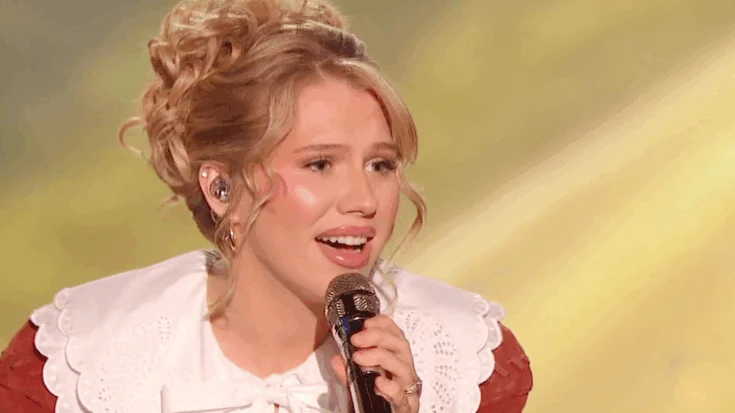
That’s where American Idol contestant Hannah Harper quietly separated herself.
She didn’t approach the song like a relic. She approached it like a living thing.
While many contestants lean on nostalgia as a crutch—replicating tone, mimicking phrasing, even borrowing emotional cues—Harper did something far more unsettling. She removed the comfort. Not entirely, but just enough to make the audience lean forward instead of settling back.
And that shift is everything.
Because classics don’t survive through imitation. They survive through reinterpretation.
What Harper changed first was tempo—not in a technical sense, but in emotional pacing. Where the original version of “Heads Carolina, Tails California” carries a forward-driving, almost carefree energy, Harper introduced restraint. She let certain lines breathe longer than expected, almost as if she was remembering the story rather than narrating it.
That subtle delay creates tension.
It transforms the song from a journey into a reflection.
And reflection is far more dangerous to the listener.

Then came her vocal texture—arguably the most overlooked weapon in her performance. Harper resisted the temptation to “clean up” the song. Instead, she allowed fragments of imperfection to remain. Slight cracks, gentle grain, moments where the voice felt less like an instrument and more like a confession.
In a competition built on precision, she chose vulnerability.
And vulnerability is harder to judge—but easier to feel.
Another critical shift was her relationship with the audience. Most performers project outward, trying to fill the room, to reach every corner with volume and clarity. Harper, however, seemed to pull the room inward. Her delivery felt almost private, as if the audience was overhearing something they weren’t meant to hear.
That changes the power dynamic.
Instead of performing to the audience, she invited them into the performance.
And once that boundary dissolves, the experience becomes personal.
But perhaps the most significant change—the one most people sensed but couldn’t articulate—was her refusal to chase the song’s original identity. “Heads Carolina, Tails California” has always carried a sense of youthful escape, a spontaneous decision to leave everything behind.
Harper didn’t erase that.
She aged it.
Her version felt like someone looking back on that same decision years later, carrying both the thrill and the consequences. There was a weight beneath the lightness, a quiet understanding that freedom often comes with a cost.
That duality gave the performance depth.
It’s the difference between telling a story and having lived it.
And this is what many others miss when they revisit classics: they try to match the moment the song was born in, instead of placing it in the moment they themselves are living in.
Harper didn’t borrow time.
She translated it.
Even her physical stillness played a role. Where others might move, gesture, or emphasize beats to keep the performance visually engaging, she reduced movement to near stillness. It wasn’t a lack of stage presence—it was control. Every minimal motion carried intention, making the audience hyper-aware of even the smallest shift.
Stillness, in her hands, became louder than movement.
And in a show where spectacle often wins attention, she proved that restraint can command it.
This is where Harper’s instincts as a storyteller become undeniable. She doesn’t just sing songs—she repositions them. She finds the space between what the song was and what it can become, and then she lives in that space long enough for the audience to follow.
That requires risk.
Because not everyone will recognize the change immediately.
Some will feel it before they understand it.
Others will resist it entirely.
But the ones who do understand—that’s where the connection deepens.
And that’s the real strategy behind her performances. Not viral moments. Not technical domination. But emotional residue. The kind that lingers long after the performance ends, quietly reshaping how people remember the original.
In the end, Harper didn’t just revisit a classic.
She revealed what it sounds like when a song grows up—and in doing so, she may have changed how every future contestant approaches one… even if they don’t realize it yet.