
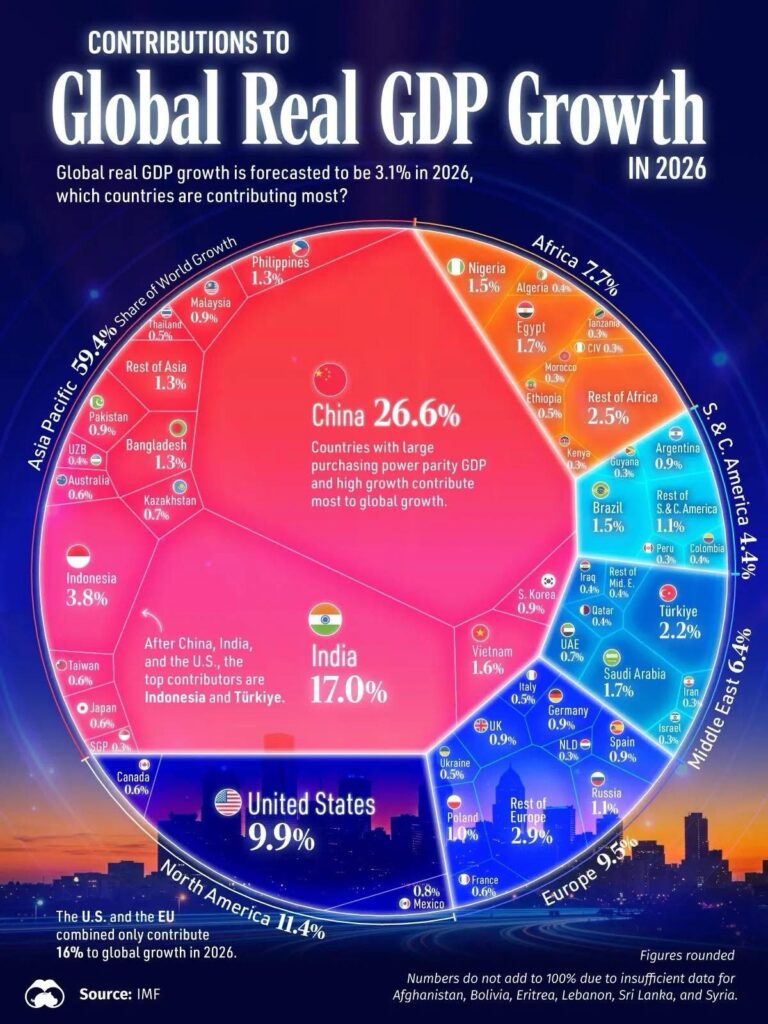
For decades, when the U.S. sneezed, the world caught a cold. But in 2026, the global economy is breathing through a different set of lungs.
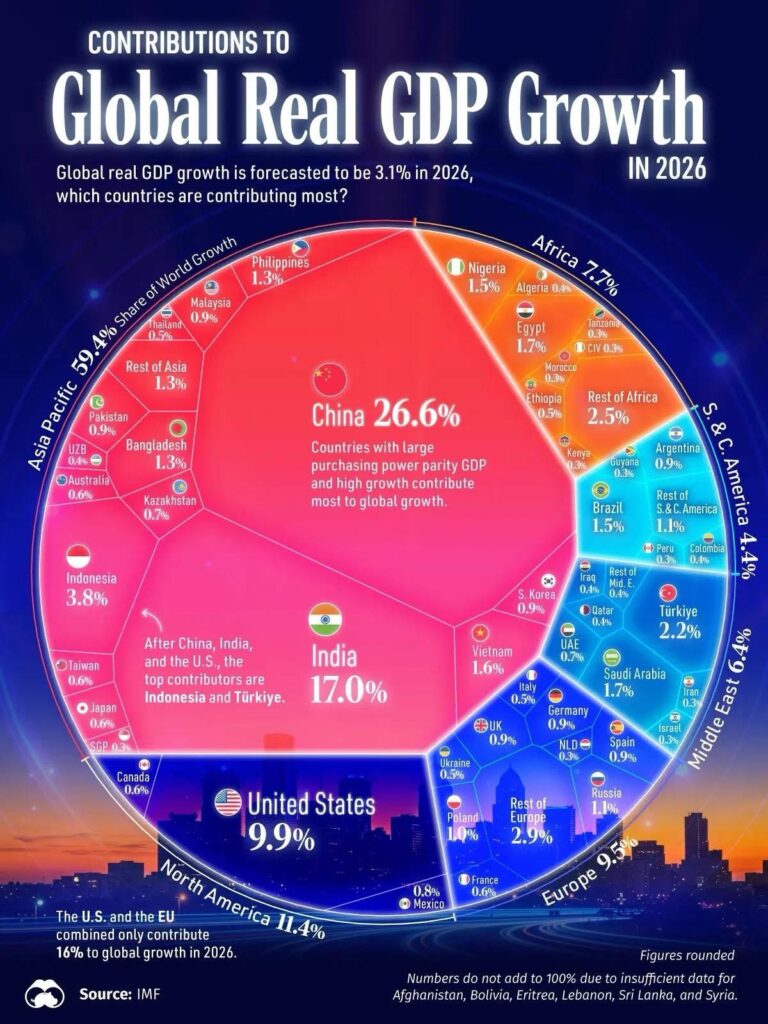
Recent data from the International Monetary Fund (IMF) reveals a staggering reality: the world’s \bm{3.1\%} to \bm{3.3\%} expansion this year isn’t being driven by the traditional heavyweights of the West. Instead, a massive 43.6% of all global growth is coming from just two nations: China and India.
If you feel like the ground is shifting beneath your feet, it’s because it is. Here is a deep dive into what this “Great Tilt” means for our collective future.
The Power Players of 2026
While the headlines often focus on volatility, the sheer volume of output from emerging Asia is breathtaking. Here is how the contributions to global real GDP growth break down this year:
1. China: The Heavyweight Champion
Despite talks of “slowing” growth rates, China remains the single largest driver of the world economy. Its \bm{4.2\%} growth rate might be lower than its double-digit glory days, but because its economy is now so massive, that \bm{4.2\%} adds more total value to the world than almost any other region combined.
2. India: The Velocity King
India is currently the fastest-growing major economy, projected to expand at roughly 6.2%. With a young workforce and a massive digital transformation underway, India is no longer just a “back-office” hub—it is a primary consumption engine.
3. The “Middle Powers” Rise
It’s not just the big two. Countries like Indonesia and Vietnam are contributing significant slices to the pie, helping the Asia-Pacific region claim nearly 60% of total worldwide expansion.
What Does This Mean for the Future?
This isn’t just about who has the most money; it’s about who sets the rules. Here are three ways this shift will change our lives:
A New Consumer Gravity
For businesses, the “average consumer” is no longer a suburban American or a European professional. The “average consumer” is now likely part of the rising middle class in Mumbai, Jakarta, or Shenzhen. Expect products, entertainment, and technology to be designed for Asian tastes and needs first, with the West becoming a secondary market.
The Rise of “Multi-Alignment”
We are moving away from a unipolar world. As emerging markets gain economic “heft,” they are becoming more assertive. We’re seeing a rise in “multi-alignment,” where nations trade freely with both the U.S. and China, refusing to choose sides. This makes global supply chains more complex but potentially more resilient.
The Innovation Leapfrog
Emerging markets aren’t just copying Western tech; they are leapfrogging it. From mobile payment systems that bypassed credit cards to AI-driven logistics tailored for high-density cities, the next “big thing” in tech is more likely to be born in an Asian tech hub than in Silicon Valley.
The Bottom Line
The 2026 IMF forecast is a wake-up call. While advanced economies like the U.S. (\bm{9.9\%} share) and the Eurozone (\bm{2\%} share) remain wealthy and influential, they are no longer the primary movers of the needle.
The future is younger, faster, and distinctly Eastern. Whether you are an investor, a business owner, or just a curious observer, it’s time to start looking toward the new horizon.