
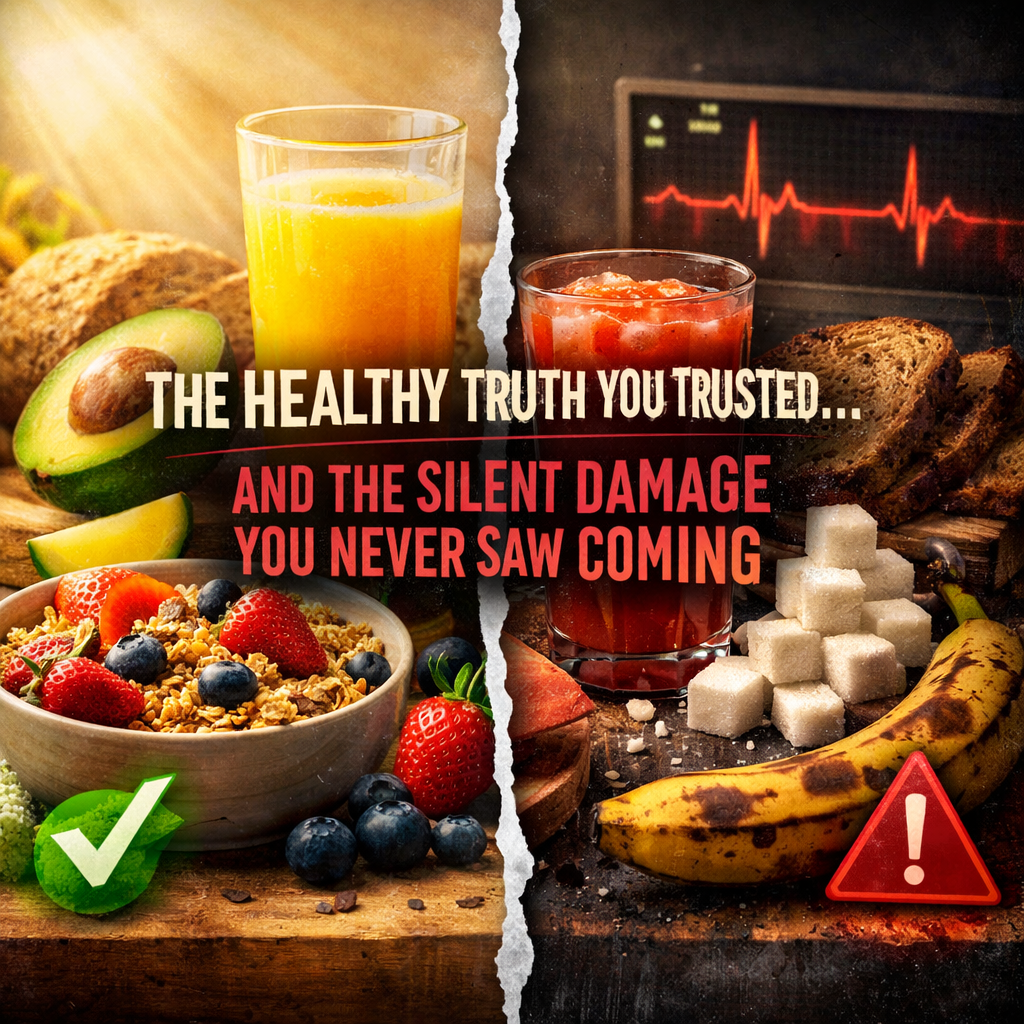
You didn’t start eating “healthy” by accident. Somewhere along the way, you chose discipline over indulgence, labels over cravings, control over chaos. And yet, beneath that quiet confidence, there’s a possibility most people never confront: what if your healthiest habits are built on half-truths?
Health, as it turns out, is not a fixed idea. It evolves, adapts, and sometimes deceives. The foods we trust the most often carry invisible conditions—portions, timing, combinations—that quietly determine whether they heal or harm. But these conditions are rarely discussed. They don’t sell well. Simplicity does.
Take the everyday breakfast ritual. A bowl of granola, a splash of yogurt, maybe some fruit. It looks like a wellness advertisement brought to life. But behind that aesthetic is a calorie density few people calculate, sugar levels masked by words like “organic” and “natural,” and a metabolic response that resembles dessert more than discipline.
Or consider fruit juice—the symbol of purity. It feels clean, refreshing, almost virtuous. But when fruit loses its fiber, it also loses its restraint. What remains is a fast-moving surge of sugar that your body processes with urgency, not gratitude. You’re not nourishing yourself—you’re flooding a system that was designed for balance.
Even something as revered as avocado carries its own quiet contradiction. Celebrated for its healthy fats, it slips easily into excess because it feels safe. But health without awareness becomes indulgence in disguise. One extra serving here, a little more there, and suddenly “clean eating” begins to mirror the very habits it replaced.
Then there’s brown bread—the illusionist of modern diets. Its color signals wholesomeness, its texture suggests depth, but often, it’s nothing more than refined flour dressed in darker tones. The danger isn’t the bread itself; it’s the trust we place in appearances over ingredients.
Bananas, too, play a subtle game. They energize, replenish, and support performance—but only when aligned with need. Eaten absentmindedly, especially in low-activity periods, they become less of a tool and more of a surplus. Context, not content, defines their impact.
What connects all these foods isn’t deception—it’s misunderstanding. None of them are inherently bad. In fact, they are among the most nutritionally valuable options available. But nutrition without intention becomes noise, and noise leads to imbalance.
The real shift happens when you stop asking, “Is this healthy?” and start asking, “Is this right for me, right now, in this amount?” That question changes everything. It replaces blind trust with conscious choice, turning eating into a dialogue rather than a routine.
Because the truth is, your body is not reacting to labels—it’s responding to behavior. It doesn’t recognize trends or marketing claims. It only understands inputs, timing, and patterns. And when those are misaligned, even the healthiest foods can quietly work against you.
So the next time you reach for something labeled “good,” pause—not out of fear, but out of awareness. Because health isn’t built on what you eat once. It’s built on how you eat, repeatedly, when no one is watching.