
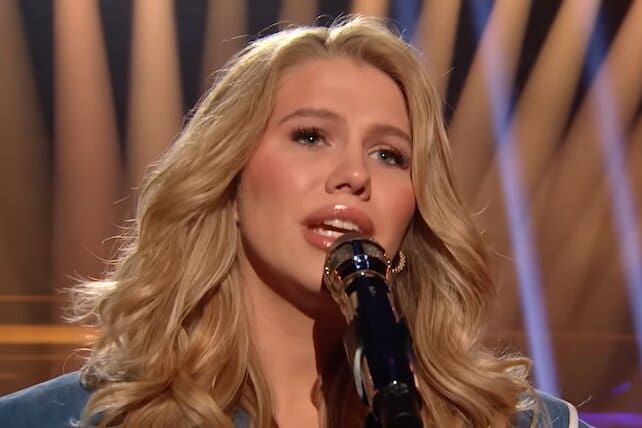
There’s a kind of support you can hear—and then there’s the kind you can’t. Hannah Harper’s journey seems to be carried not by the noise of trending clips or viral debates, but by something far quieter. It doesn’t flash. It doesn’t demand attention. Yet it moves her forward, week after week, with a steadiness that feels almost invisible. And that’s exactly what makes it powerful.
Because Harper’s voters don’t behave like a crowd.

They behave like a commitment.
In most televised competitions, visibility is often mistaken for dominance. The louder the fanbase, the stronger the perception of control. But Harper exists outside of that equation. Her support system doesn’t need spectacle to function. It operates in silence—through routine, through habit, through a deep, almost personal alignment with who she is on stage.
This isn’t excitement. It’s recognition.
And recognition lasts longer than hype.
Harper’s appeal doesn’t rely on shock value or dramatic reinvention. Instead, it leans into something far more psychologically sticky: emotional familiarity. Her performances feel grounded, her tone unforced, her presence unpretentious. For many viewers, she doesn’t feel like a contestant trying to win. She feels like someone they already know.
And people don’t abandon what feels familiar.
There’s a behavioral pattern hidden here—one that explains why her votes don’t spike wildly, but also don’t collapse. It’s what psychologists would describe as consistent reinforcement. Each week, her audience receives exactly what they expect—not in a predictable, boring way, but in a reassuring, reliable way. That consistency strengthens trust. And trust, once formed, doesn’t fluctuate easily.
It stabilizes.
While others rise and fall on moments, Harper builds on continuity.

Another layer lies in the emotional identity of her audience. Many of her voters aren’t just choosing a voice—they’re choosing a reflection. Her country-rooted style, her subtle storytelling, her restraint instead of excess—it all mirrors values that feel deeply personal to a specific group of viewers. Supporting her becomes more than a vote. It becomes a quiet form of self-expression.
And self-expression is fiercely protected.
This is why her support doesn’t need validation. It doesn’t need to trend. It doesn’t need to be seen to be real. Unlike louder fanbases that thrive on collective visibility, Harper’s voters are individually anchored. They don’t vote because others are voting. They vote because they decided to—and that decision repeats itself without needing reinforcement from the outside.
That independence makes her base unusually durable.
There’s also a strategic advantage hidden in her lack of overexposure. Harper isn’t constantly surrounded by controversy, excessive praise, or overwhelming narrative arcs. She exists in a controlled emotional space—present, but not saturated. This prevents fatigue. Audiences don’t feel overwhelmed by her presence, which means they don’t subconsciously pull away.
Instead, they stay.
Quietly. Consistently.
And then there’s the paradox of perception. Because her support isn’t loud, it’s often underestimated. Other contestants may appear more dominant because their fanbases are more visible. But visibility can be deceptive. It creates the illusion of strength, while Harper’s strength remains unmeasured until it manifests in results.
By the time it’s noticed, it’s already working.
This is the difference between noise and weight.
Noise fills space. Weight shifts outcomes.
As the competition tightens and casual voters fade, this kind of loyalty becomes even more decisive. The audience that remains is no longer voting casually—they are voting with intention. And intention favors those who have built something deeper than momentary attention.
It favors those who have built trust.
In the end, Harper’s journey isn’t defined by how loudly she is supported, but by how consistently she is chosen. Her voters don’t need to announce themselves. They don’t need to dominate timelines. They simply show up, again and again, without hesitation.
And in a system where every vote carries equal value, that quiet repetition becomes unstoppable.
Because the strongest force in any competition isn’t always the one you hear the most.
It’s the one that never stops showing up.