

There’s a quiet danger in familiar songs—one that doesn’t announce itself, doesn’t feel threatening, and yet silently dismantles performances before they even begin. It’s not about vocal ability or stage presence. It’s about expectation. The moment a song is recognized, the audience stops listening for discovery and starts listening for comparison.

And comparison is where most performances collapse.
On American Idol, this risk becomes even sharper. The audience doesn’t just remember the original—they carry emotional attachments to it. Every note has a reference point. Every pause has a history. So when a contestant chooses a well-known song, they’re not just performing—they’re stepping into something already owned by millions.
And ownership is difficult to challenge.
Most performers respond to this pressure in predictable ways. They either imitate the original too closely, hoping familiarity will win approval, or they overcompensate—adding unnecessary vocal runs, dramatic changes, or excessive power to “stand out.” But both approaches miss something crucial.
They keep the original at the center.
And that’s the trap.
Because when the original remains the focal point, the performer becomes secondary. The audience listens through the performance instead of to it. They measure, they compare, they recall. And in that process, the present moment loses its weight.
Hannah Harper understood this risk instinctively.
Instead of fighting the original or clinging to it, she did something far more strategic—she shifted the center of gravity. The song was no longer the main subject. She was. Not through dominance, not through overpowering technique, but through perspective.

She changed how the story felt.
Take “Heads Carolina, Tails California” as an example. The original thrives on youthful spontaneity, on the excitement of leaving everything behind without hesitation. It moves quickly, almost impulsively, mirroring the emotion it carries.
But Harper didn’t chase that emotion.
She reframed it.
Her version felt less like a decision in motion and more like a decision remembered. The excitement was still present, but it was layered with reflection—almost as if the story had been lived, processed, and revisited with new understanding.
That shift did something subtle but powerful.
It broke the comparison.
Because you can’t directly compare two different emotional timelines. The original exists in the present moment of the story. Harper’s version exists in its aftermath. One is about leaving. The other is about what leaving meant.
And that distinction changes everything.
Another way she avoided the trap was through restraint. Familiar songs often tempt performers to prove themselves—to show vocal range, control, and versatility. But over-singing a well-known track can feel like rewriting something that didn’t ask to be rewritten.
Harper resisted that urge.
She didn’t add more. She removed just enough.
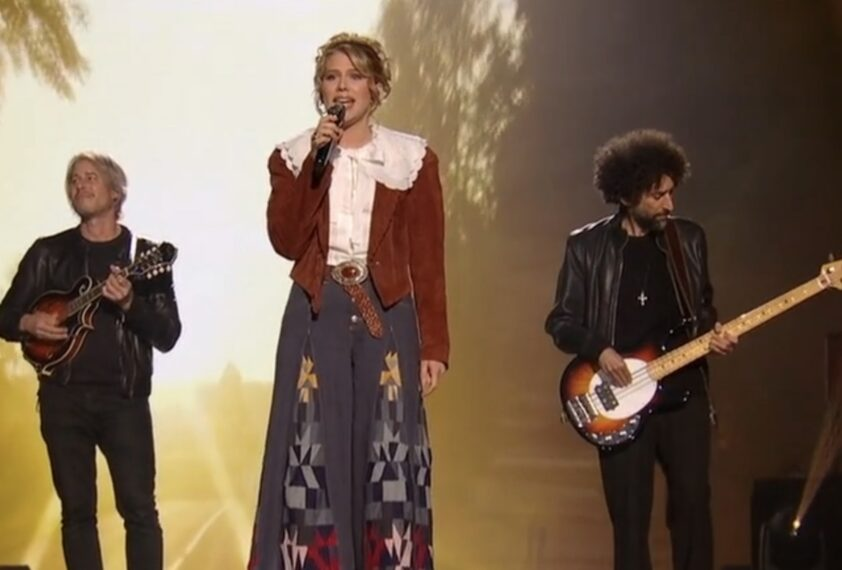
Her phrasing was intentional, her delivery controlled, her voice allowed to carry natural textures instead of polished perfection. That restraint created authenticity. And authenticity is far more disarming than technical brilliance when dealing with something familiar.
Because the audience stops evaluating.
They start feeling.
There’s also an emotional intelligence behind her choices that often goes unnoticed. She seemed to understand that familiarity doesn’t need to be erased—it needs to be redirected. Instead of trying to make the song sound “different” in obvious ways, she made it feel different in quiet ones.
A longer pause.
A softer entry.
A line delivered as if it carried history instead of immediacy.
These are not dramatic changes. They are internal shifts. But internal shifts create external impact.
And that’s where her performance became something more than safe.
It became intentional.
What makes this even more compelling is how invisible her strategy felt. Many viewers couldn’t articulate what she had done differently. They just knew it didn’t feel like a copy. It didn’t feel like a competition piece trying to impress. It felt… lived-in.
And that’s the highest form of reinterpretation.
Not when the audience notices the change—but when they forget to look for the original.
Because at that point, the risk is gone.
There is no longer a comparison to win or lose.
There is only a moment to experience.
And that’s what Harper created—a space where the song belonged to her without needing to declare ownership. She didn’t overpower familiarity. She moved through it, gently shifting its meaning until it aligned with her own voice, her own story, her own timing.
That’s not easy.
It requires confidence, restraint, and a deep understanding of storytelling.
But more than anything, it requires the courage to not perform for recognition, but through it.
In the end, the real risk of familiar songs isn’t that people will compare—it’s that they’ll never stop comparing.
And Harper’s quiet brilliance was in giving them a reason to.