
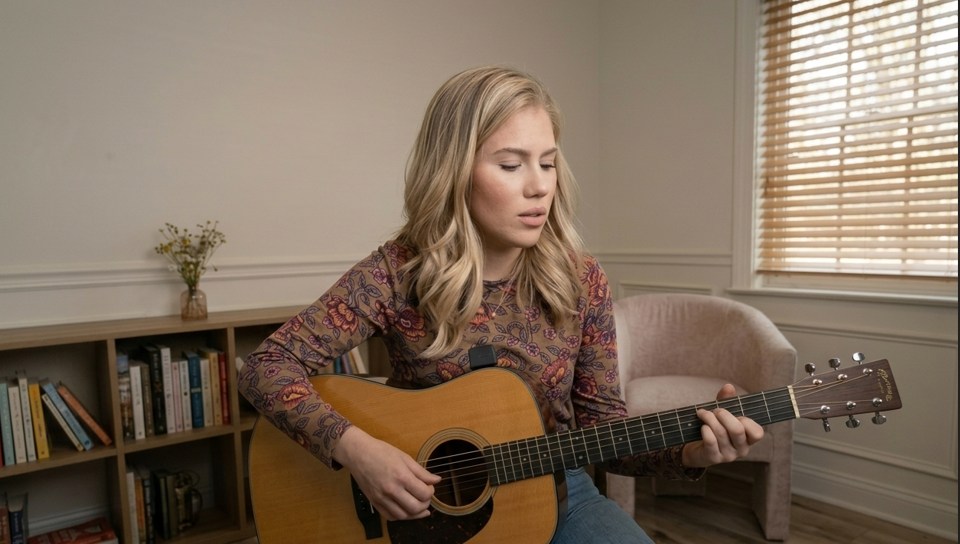
There’s something quietly disruptive about the way Hannah Harper builds a song. It doesn’t follow the expected path. It doesn’t arrive neatly packaged. Instead, it feels like it’s unfolding in real time—almost as if the music is discovering itself while you listen.

In an industry where structure is everything—verse, chorus, hook, repeat—her approach feels almost rebellious. She doesn’t seem concerned with where a chorus should land or how a bridge should elevate. She lets the emotion decide. And somehow, that lack of rigid design becomes the very thing that holds everything together.
Her songs breathe.
There are pauses that don’t feel like pauses. Lines that don’t resolve the way you expect. Melodies that bend instead of landing clean. And yet, none of it feels broken. It feels human—like a conversation that doesn’t follow a script but still says exactly what it needs to say.
That’s the paradox of her artistry. What appears unpolished is actually deeply intentional in its honesty.
You can hear it in the way she lingers on certain words, almost like she’s not ready to let them go. Or how she allows silence to carry weight instead of filling every space with sound. These are choices most performers are trained to avoid. But she leans into them.
Because life itself isn’t structured.
We don’t speak in perfect arcs. We don’t feel in predictable rhythms. And somehow, her music understands that. It mirrors the unevenness of real emotion—the way memories interrupt, the way thoughts trail off, the way feelings arrive without warning.
That’s why her songs don’t feel performed. They feel remembered.
There’s a rawness in her delivery that refuses to be smoothed out. You can almost hear the edges—the slight imperfections, the shifts in breath, the moments where her voice cracks just enough to reveal something underneath. And instead of weakening the song, those details strengthen it.
They make it believable.

In contrast, so much of modern music is engineered for precision. Every note corrected, every beat aligned, every second optimized. It’s clean, it’s polished, it’s technically flawless. But often, it’s distant.
Hannah’s music takes the opposite route.
It trades perfection for presence. It sacrifices symmetry for sincerity. And in doing so, it creates something that doesn’t just sound good—it feels real. There’s a difference between hearing a song and experiencing it. Her music leans firmly into the latter.
And perhaps the most striking part is that she never forces it.
There’s no sense of trying to be different. No visible effort to break rules or redefine structure. It simply happens because she’s following the emotion wherever it leads. The structure becomes secondary. The feeling comes first.
That’s what makes it so compelling.
Listeners don’t just follow along—they participate. They fill in the spaces. They sit in the pauses. They complete the thought without realizing it. It creates an intimacy that polished compositions often struggle to achieve.
You’re not just hearing her story.
You’re finding your own inside it.
And that’s where the magic lives—in that quiet intersection between what’s sung and what’s felt. Where the lack of structure becomes a kind of freedom. Where the unfinished edges invite something deeper.
Because when everything is perfectly constructed, there’s no room left for the listener.
But when something is left slightly open, slightly imperfect, slightly unresolved—it breathes. It moves. It lives.
And so do the people listening to it.