

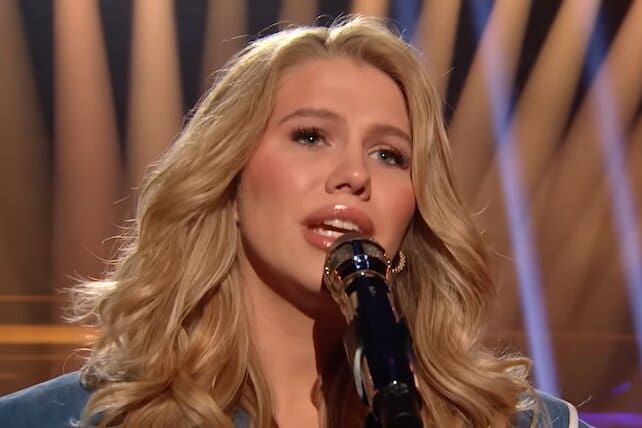
There are performances that land. And then there are performances that linger — not just in the ears, but somewhere deeper, quieter, harder to explain. When Hannah Harper stepped into her Top 11 moment on American Idol, something shifted before she even finished the first line.

It wasn’t just about hitting the notes of “Heads Carolina, Tails California.” It was about what she carried into them. There was a steadiness in her delivery — not forced, not over-rehearsed — but lived-in. The kind of voice that doesn’t ask for attention, yet somehow holds it completely.
And maybe that’s what made the reaction so immediate.
Because when Jo Dee Messina — the very voice that once defined that song — reportedly found herself emotional, it wasn’t just nostalgia. It was recognition. Recognition of something rare: a performance that doesn’t imitate, but translates.
Harper didn’t try to outshine the original. She didn’t decorate it with unnecessary runs or push it into something louder than it needed to be. Instead, she did something far more difficult — she trusted the simplicity of the story. And in doing so, she made it feel like it belonged to her.
That’s where the moment began to grow.
Because when Carrie Underwood added her voice to the praise, it wasn’t just another compliment from a judge. It carried weight — not just because of who she is, but because she understands what it takes to stand in that exact position and turn a familiar song into something unforgettable.
Two artists. Two different eras. One shared reaction.
That doesn’t happen by accident.
There was a quiet confidence in Harper’s performance that didn’t need validation — yet somehow earned it anyway. She didn’t chase the moment. She allowed it to arrive. And in a competition where louder often feels safer, she chose restraint… and it worked.
Fans noticed. Not in a sudden explosion, but in a steady, undeniable wave. Conversations shifted. Clips circulated. And what stood out wasn’t just the performance itself, but the feeling it left behind — that subtle sense that something genuine had just taken place.
Because authenticity, when it’s real, doesn’t announce itself.
It reveals itself slowly — in the way a note is held just a second longer than expected, in the way a lyric feels spoken rather than sung, in the way an audience leans in instead of erupting. Harper’s moment lived in those details.
And maybe that’s why it’s staying.
Not because it was the biggest performance of the night. Not because it was the most technically complex. But because it felt honest in a way that’s increasingly rare on a stage built for spectacle.
There’s a difference between performing a song and understanding why it was written. And somewhere between those two spaces, Harper found her ground.
Now the conversation is changing.
It’s no longer just about whether she can advance — that question feels almost secondary. The real question is whether moments like this can continue. Whether this quiet, steady presence can outlast louder, flashier competitors in a format that often rewards immediacy over memory.
Because if it can…
Then this wasn’t just a standout performance.
It was the kind of turning point people only recognize fully after everything is already decided.