
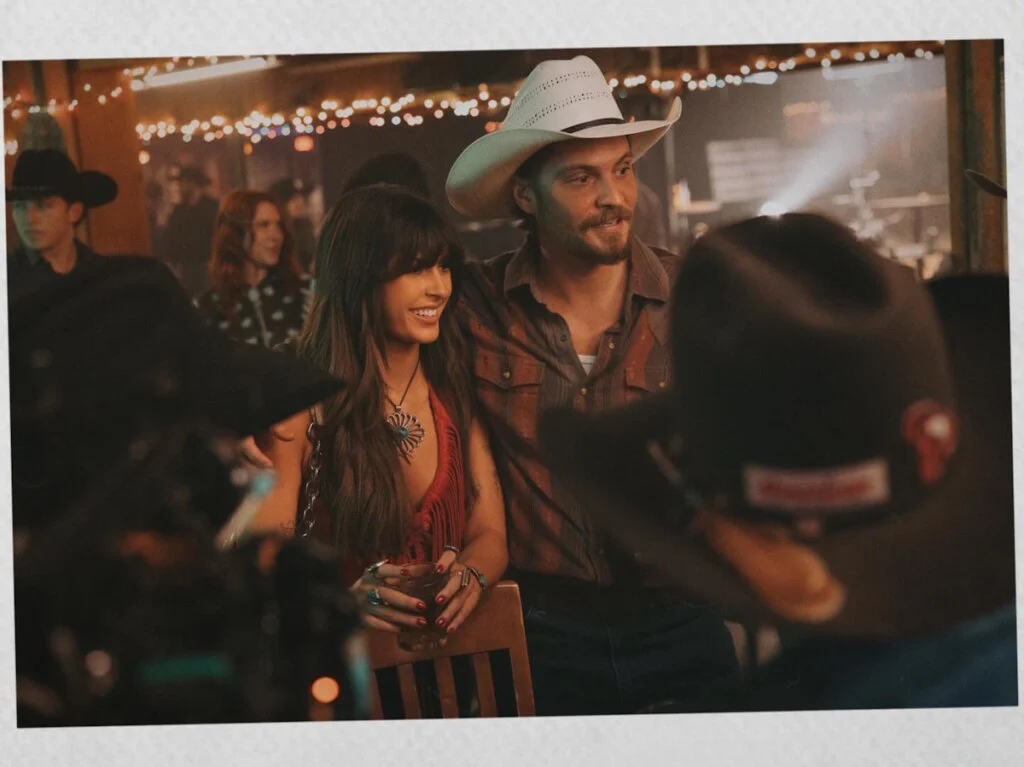
There are music videos… and then there are moments that feel like they’re quietly rewriting the rules of how stories are told in country music. What Ella Langley has delivered with “Choosin’ Texas” doesn’t simply fall into the first category—it pushes boldly into the second, where performance dissolves into narrative, and narrative begins to feel uncomfortably real.
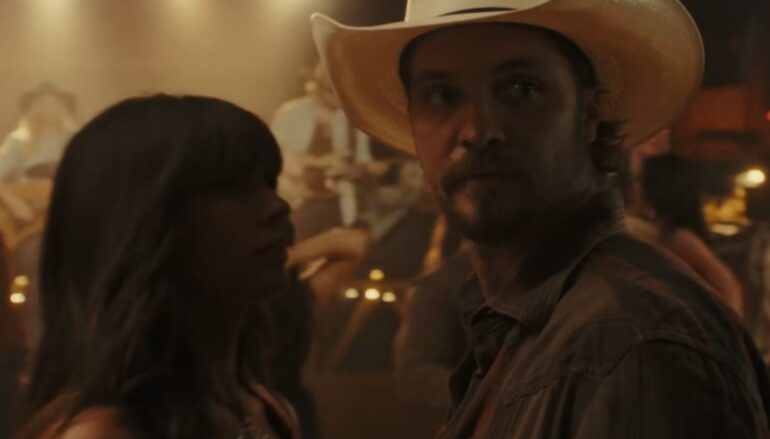
From its opening frames, the video refuses to behave like a traditional release. There’s no rush to impress, no immediate hook designed for virality. Instead, it builds—slowly, deliberately—drawing the viewer into a world thick with dust, tension, and something unspoken lingering beneath every glance. It’s not just visual storytelling; it’s atmospheric immersion.
At the center of it all stands Langley herself, not merely as a singer but as a character navigating emotional terrain that feels almost too intimate for the screen. Her performance doesn’t beg for attention—it holds it, quietly and completely. Every expression carries weight, every pause feels intentional, as if silence itself is part of the script.
Opposite her, Luke Grimes brings a grounded intensity that anchors the unfolding tension. There’s a restraint in his presence, a sense that what he’s not saying matters more than what he does. And then there’s Ava Phillippe—a subtle yet powerful force in the triangle—whose role introduces a quiet unpredictability that keeps the emotional balance constantly shifting.
What makes this dynamic so compelling isn’t just the idea of a love triangle—it’s how it’s executed. There are no exaggerated confrontations, no overly dramatic declarations. Instead, the story leans into glances, distance, proximity—the fragile space between people where decisions are made without words.
And just when the narrative begins to settle into a rhythm, the video expands its world in a way that feels both surprising and perfectly placed. The appearance of Miranda Lambert doesn’t feel like a cameo—it feels like a passing of energy, a quiet nod from one force in country music to another. It adds depth, not distraction.
The inclusion of real rodeo riders and lived-in environments adds another layer of authenticity that can’t be manufactured. You don’t feel like you’re watching actors in a set—you feel like you’ve stepped into a place that already existed long before the cameras arrived. That’s the difference. That’s why it lingers.
But what truly sets “Choosin’ Texas” apart is its refusal to resolve itself in a way that feels comfortable. There’s a moment—fleeting, almost easy to miss—where everything seems to pivot. A look. A hesitation. A choice that isn’t fully explained, only felt. And it’s in that moment that the video shifts from something you watch… to something you question.

Fans aren’t just reacting to the visuals—they’re responding to the ambiguity. Social media isn’t filled with simple praise; it’s filled with theories, interpretations, emotional responses that go beyond surface-level admiration. People aren’t asking if it’s good—they’re asking what it means.
That’s a rare space for a music video to occupy. Most are consumed and moved past. This one invites you to stay, to rewind, to look closer. It doesn’t give you everything. It trusts you to find something on your own—and that trust is what makes it powerful.
There’s also a deeper shift happening here, one that feels subtle but significant. In an era where attention spans are shrinking and content is often built for immediacy, Langley leans in the opposite direction. She slows things down. She creates tension through restraint. And somehow, that makes it even harder to look away.
Because in the end, “Choosin’ Texas” isn’t just about who chooses who. It’s about the weight of choosing at all—the consequences, the silence that follows, the things left unsaid. It’s about the kind of decisions that don’t come with clear answers, only lingering echoes.
And maybe that’s why it’s hitting so deeply. Not because it’s dramatic, but because it feels honest in a way that’s difficult to define.
So when fans call it “Music Video of the Year,” they might not just be reacting to what they saw.
They might be reacting to what they felt—and what they still can’t quite explain.