
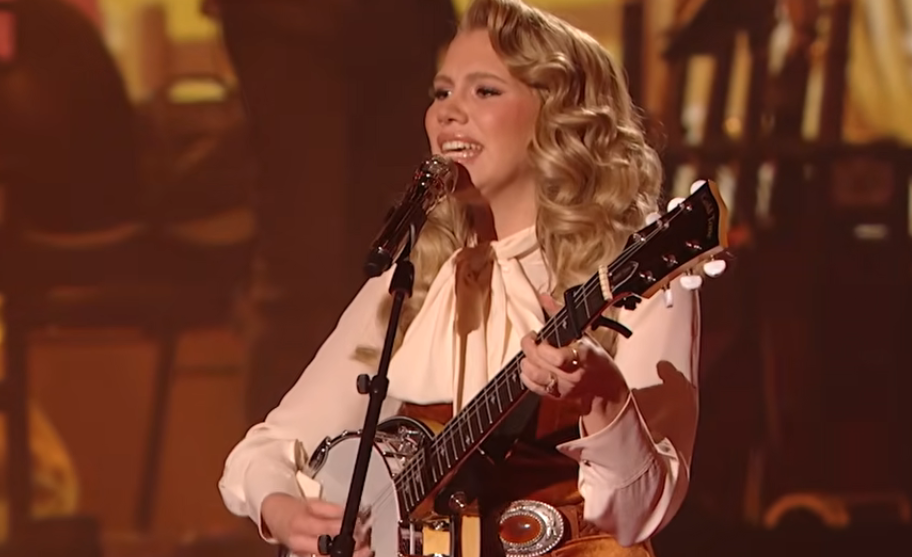
There’s a certain kind of question that lingers in the air during competitions like American Idol—not spoken loudly, but felt deeply: can someone unexpected rise and redefine the narrative? When Hannah Harper walked onto that stage, that very question seemed to follow her. A Missouri mom, a quiet contender, and yet, something about her presence suggested this wouldn’t be ordinary.

From the first note, it was clear she wasn’t trying to impress—she was trying to connect. Choosing a ballad by Merle Haggard was not just a musical decision; it was a statement. His songs carry a weight of history, of truth, of lived experience. To step into that space requires more than talent—it requires honesty. And Hannah didn’t just step in; she settled into it.
The performance wasn’t loud or flashy. It didn’t rely on vocal acrobatics or dramatic gestures. Instead, it leaned into something far more powerful—restraint. Every line she delivered felt measured, intentional, and deeply personal. This wasn’t about showcasing range; it was about revealing soul.
What made the moment even more compelling was the story behind it. Singing to honor her husband, Hannah infused the performance with a kind of vulnerability that cannot be manufactured. It wasn’t something rehearsed into perfection—it was something lived into truth. You could feel it in the slight tremble of certain notes, in the pauses that carried more meaning than words ever could.
And then came the shift.
There’s always a moment in a truly great performance where everything aligns—the voice, the emotion, the silence in the room. For Hannah, that moment didn’t explode; it unfolded. Slowly, deliberately, until the entire space felt suspended in what she was creating. The audience wasn’t just listening anymore—they were feeling.
The judges’ reactions told their own story. Luke Bryan, known for recognizing authentic country artistry, didn’t just praise her—he felt her. His reaction wasn’t about technical perfection; it was about something deeper. When he compared her to some of the greatest names in country music, it didn’t feel exaggerated. It felt earned.
That’s the thing about country music at its core—it’s not about perfection, it’s about truth. And in a world where performances often lean toward spectacle, Hannah’s simplicity became her greatest strength. She reminded everyone watching that sometimes, the quietest moments carry the loudest impact.
What makes this performance stand out isn’t just how it sounded in the moment—it’s how it lingers. Long after the final note faded, there was a sense that something important had just happened. Not a viral moment, not a flashy headline, but a genuine connection that stays with you.
In competitions, frontrunners often emerge through consistency or popularity. But occasionally, someone shifts the conversation entirely. Hannah didn’t just perform well—she changed how people were looking at her. Suddenly, she wasn’t just a contestant with potential. She was a contender with presence.
And perhaps that’s where the real transformation lies. Not in the notes she hit, but in the space she created. A space where tradition met vulnerability, where a classic song found new life, and where a Missouri mom didn’t just ask for a chance—she claimed her place.
So, can a Missouri mom become the next queen of country?
After that performance, it no longer feels like a question. It feels like the beginning of an answer.