
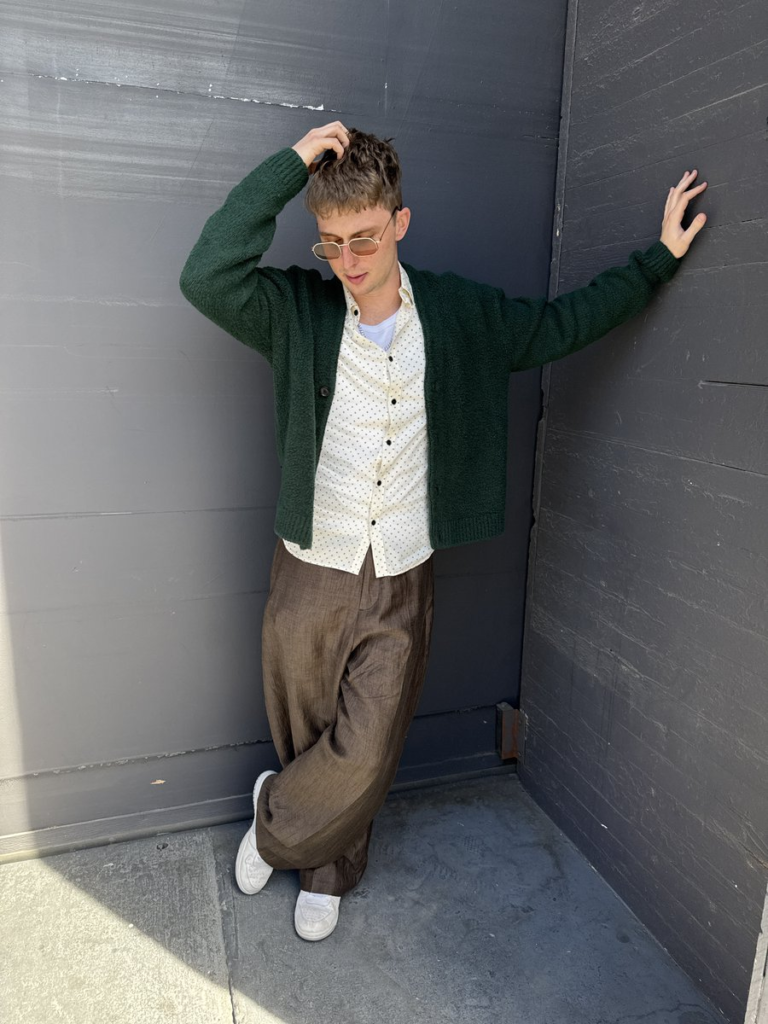
There are nights on American Idol when preparation meets opportunity—and then there are nights when instinct, courage, and raw artistry collide to create something entirely unexpected. What Braden Rumfelt delivered on Taylor Swift Night wasn’t just impressive; it was almost improbable. Because behind the confidence, behind the control, was a truth that made the performance even more remarkable—he barely knew the song a week ago.

That revelation alone reshapes everything.
“Cardigan,” a song by Taylor Swift, isn’t just any track. It’s layered, introspective, emotionally intricate. It demands nuance more than power, storytelling more than spectacle. To approach a song like that without years of familiarity is a risk. But Braden didn’t treat it like a risk—he treated it like a canvas.
From the moment he began, there was no trace of uncertainty. No hesitation. What the audience saw was ownership. What they heard was understanding. And that’s what made it so compelling—he didn’t sing it like someone learning the song; he sang it like someone who had lived inside it.
That transformation didn’t happen by accident.
There’s a certain artistry in interpretation—the ability to take someone else’s story and make it feel like your own without losing its essence. Braden found that balance. He didn’t imitate Taylor Swift’s delivery. He respected it, then reimagined it. And in doing so, he created something that felt both familiar and entirely new.
As the performance unfolded, something shifted in the room.
It wasn’t loud. It wasn’t dramatic. It was subtle, almost quiet. The kind of shift you feel before you fully understand it. The audience leaned in. The judges grew still. Because what was happening on that stage wasn’t just technically strong—it was emotionally precise.
And then came the reaction that changed everything.
When Taylor Swift herself responded, it didn’t feel like a routine compliment. Calling it her favorite performance of the night carried weight—not just because of who she is, but because of what the song represents. For the creator of “Cardigan” to see her work reflected back in a new light—and to embrace it—that’s not just validation. That’s recognition.

But beyond the praise, what truly defines this moment is the contrast.
A week ago, the song didn’t even exist in Braden’s world. And yet, on that stage, it felt like it had always belonged to him. That kind of leap—from unfamiliarity to ownership—is rare. It speaks to something deeper than talent. It speaks to instinct, to musical intelligence, to the ability to connect quickly and authentically.
This is where performances like this become more than just highlights—they become turning points.
In a competition where consistency often defines frontrunners, moments like this disrupt the narrative. They remind everyone watching that growth doesn’t always happen gradually. Sometimes, it happens all at once. In a single song. In a single night.
There’s also something powerful about the risk itself.
Choosing a song you don’t fully know, stepping into an emotional space that isn’t yet familiar, and trusting yourself to make it work—that’s vulnerability. And audiences respond to that. Not because it’s perfect, but because it’s real. Braden didn’t hide the challenge—he rose through it.
And perhaps that’s why the performance lingers.
Because it wasn’t just about how well he sang. It was about what it represented. The idea that artistry isn’t always about mastery over time—it can also be about connection in the moment. The ability to understand something deeply, quickly, and truthfully.
As the night ended and the conversation began, one thing became clear: this wasn’t just another strong showing. It was a statement. A reminder that sometimes, the most unexpected stories create the most unforgettable performances.
So while the competition moves forward and new songs take the stage, this moment will remain.
Not just because Braden Rumfelt sang “Cardigan” beautifully.
But because he proved that sometimes, you don’t need years to understand a song…
You just need the courage to feel it.