
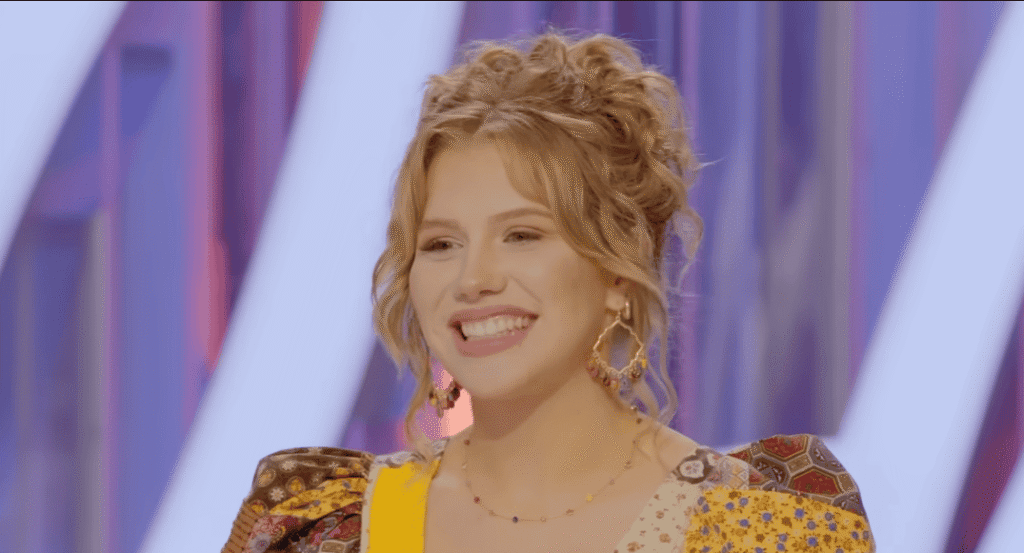
The dress caught the light before she did.
It was bright, pieced together in careful squares of color and memory, stitched by her own hands at a kitchen table that had known more spilled milk than applause. When she stepped onto the stage of American Idol, the patchwork moved softly around her knees, a small defiance against polish and expectation. She stood there, “yeehaw” and unvarnished, holding her guitar like something borrowed from home.
The stage lights were wide and white, humming faintly overhead. They flattened the vast room into something almost unreal. But she seemed to carry a different light with her — the kind that glows in hallways at midnight when the house is quiet except for a baby’s cry.
She introduced the song without ceremony. “String Cheese,” she said, and there was the faintest smile, the kind that flickers and disappears before anyone can decide what it means. Then her fingers found the strings, and the first chord landed gently in the air.
It was not a performance that reached outward. It folded inward.

The guitar sounded warm and wooden, each strum steady as breath. Her voice entered without force — not chasing power, not bending itself into shape. It felt worn-in, like denim softened by years of washing. She sang of small things: refrigerator lights glowing in the dark, half-eaten snacks on counters, the quiet fatigue that settles into the bones. The lyrics did not rush. They simply told the truth.
Somewhere in the audience, someone shifted in their seat. A cough was swallowed. The room began to listen differently.
She did not close her eyes to dramatize a line. She looked straight ahead, shoulders squared but soft, as if standing in her own kitchen again. There was exhaustion in the stillness of her posture, but also something steadier — a love that refuses to thin out even when sleep does.
By the second verse, the vastness of the stage felt smaller. The lights no longer seemed blinding. They felt almost intimate, as if illuminating something fragile and easily lost. The melody carried no acrobatics, no soaring declarations. Just a woman singing about the sacred ordinariness of motherhood, about the ache and the beauty braided together.

When she reached the final chord, it did not crash. It rested. Her hand lingered against the strings, muting their echo with the heel of her palm. Silence followed — not empty, but full.
At the judges’ table, Carrie Underwood lifted a hand to her face. It was not a dramatic gesture. Just a quiet brushing away of something that had gathered in her eyes. She searched for words, and for a moment, there were none. Then, softly, she admitted what everyone seemed to be feeling — that it was the most relatable song she had ever heard.
The applause came after, but it felt secondary. What lingered was the stillness before it — the moment when a patchwork dress stood beneath bright lights and told the truth without ornament.
Long after the stage emptied and the lights dimmed, what remained was not the spectacle, but the image of her there: steady, stitched together by her own hands, singing about string cheese and sleepless nights as if they were worthy of a spotlight. And in that quiet insistence, they were.
Love love love this ❣️