

The silence after elimination is different when you’re only sixteen. It’s not just about losing a spot—it’s about losing a version of yourself you hadn’t fully become yet. For Ruby Rae, a high school student from Pacific Palisades, that silence arrived far too soon on American Idol. One moment, she was standing among the Top 14, heart racing with possibility. The next, she was walking away—barely seen, barely heard, and somehow, already gone.
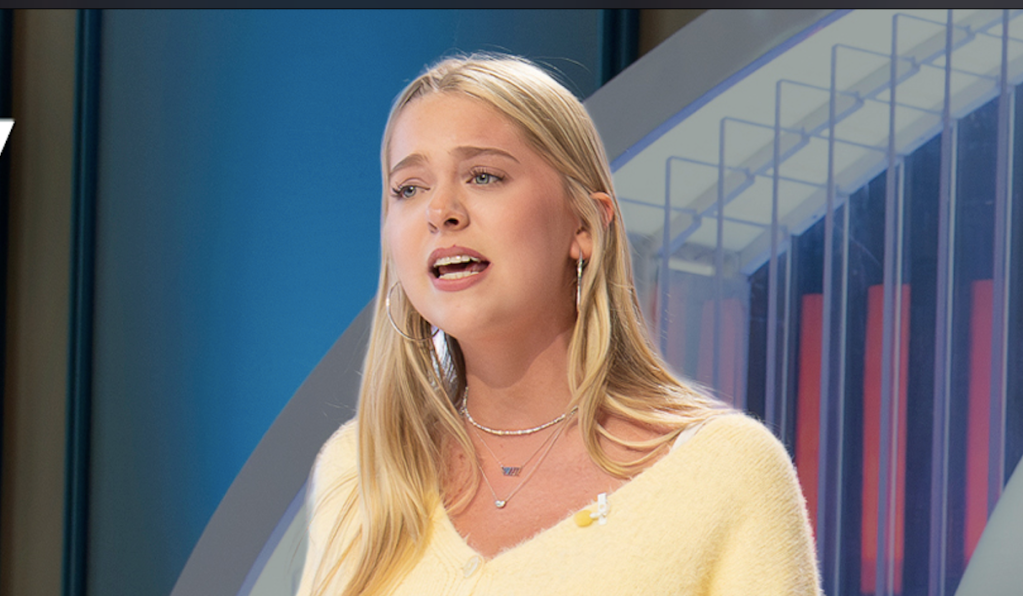
What made it harder wasn’t just the exit. It was the absence. In a competition built on storytelling, connection, and visibility, Ruby’s journey felt unfinished—not because of her talent, but because the audience never truly got the chance to witness it. No defining montage. No emotional arc. Just a quiet fade-out that left fans asking a louder question than any performance ever could: What did we miss?
When Ruby finally spoke, it wasn’t with bitterness—it was with honesty. The kind that doesn’t demand attention, but earns it. She admitted she was still stunned, still trying to process how quickly everything ended. And then came the words that changed the tone of the conversation entirely—her biggest regret wasn’t losing. It was not fully showing who she was when she had the chance.
That admission hit differently. Because it wasn’t about blame. It wasn’t about pointing fingers at producers, edits, or the unpredictability of voting. It was about something far more human—the quiet realization that sometimes, fear whispers louder than courage in the moments that matter most. And for Ruby, that whisper may have held her back just enough to remain unseen.
Fans didn’t ignore that. They felt it.
Across social media, her story began to spread—not as outrage alone, but as recognition. People saw themselves in her words. That lingering thought of “I could have done more” is universal, but hearing it from someone so young, on such a massive stage, made it echo louder. Support poured in, not just because she was eliminated, but because she represented something deeper—the fear of not being fully seen before the curtain closes.
There’s something uniquely fragile about early exits in shows like American Idol. They don’t come with closure. They don’t offer a full-circle moment. They leave stories half-written, suspended somewhere between potential and proof. And in Ruby’s case, that unfinished story became the very thing that people couldn’t stop thinking about.
Her lack of screen time became symbolic. Not just of production decisions, but of a broader truth about visibility in competitive spaces. Talent alone doesn’t guarantee recognition. Sometimes, it’s timing. Sometimes, it’s narrative. And sometimes, it’s simply whether the moment chooses you—or passes you by.

But here’s where Ruby’s story shifts.
Because speaking out transformed her exit into something else entirely.
It turned silence into voice. Absence into presence.
Her regret didn’t diminish her—it humanized her. And in doing so, it gave her something more powerful than screen time: it gave her connection. The kind that doesn’t rely on edits or airtime, but on authenticity. Suddenly, Ruby Rae wasn’t just “the contestant who left early.” She became the voice of every dreamer who ever felt like they didn’t show up fully when it counted.
And that kind of story doesn’t end with elimination.
It begins there.
Because while her journey on American Idol may have been cut short, her awareness wasn’t. Her growth wasn’t. And perhaps most importantly, her willingness to confront that moment—openly, vulnerably—suggests that this isn’t where her story peaks. It’s where it deepens.
There’s a quiet power in realizing your regret while you’re still early enough to rewrite it.
Ruby Rae is only sixteen.
And if this experience taught her anything, it’s not just how the stage works—but how she wants to show up the next time she steps onto one.
Because next time, she won’t wait to be seen.
She’ll make sure the world can’t look away.