

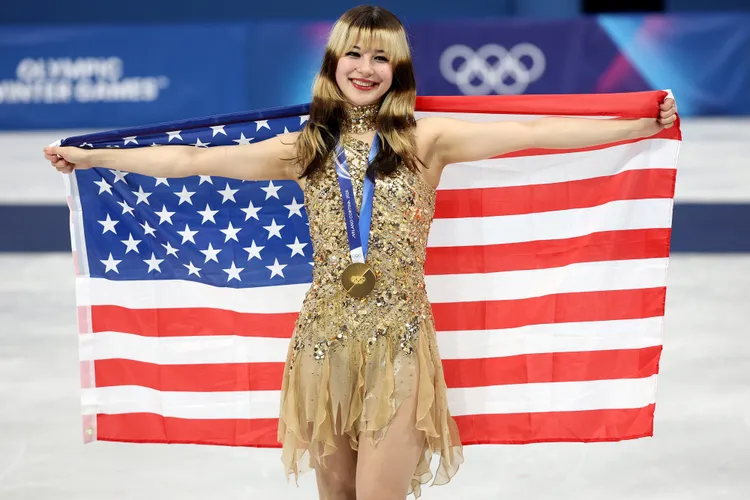
The arena lights in Milano Cortina had already faded by the time people began talking about the moment that would linger the longest. Alysa Liu stood on the Olympic podium with her medal resting against her chest, the metal catching the light every time she moved. Around her, the sound of applause still echoed in the rafters, softer now, like something already becoming a memory. Later that night, when the noise had settled and the world felt far away, she shared a simple photo with Kaori Sakamoto and Ami Nakai, three skaters close together, cheeks flushed from cold air and relief. The caption was warm, grateful, almost quiet. It felt like the end of something. It felt like the beginning too.
Among the thousands of messages that followed, one stood apart for how little it said. Michelle Kwan’s name appeared, familiar in a way that carried years with it, and beneath the photo she wrote only one word. Bravo. Nothing more. No long praise, no explanation. Just that. Fans noticed immediately, not because it was loud, but because it wasn’t. The word sat there like a small mark on the page, and yet it felt heavier than the rest of the comments combined, as if it had traveled a long distance before arriving.
People who had watched Kwan skate years earlier understood the feeling before they could explain it. They remembered the same kind of stillness before a program began, the same calm face before the music started. Seeing her name beside Liu’s felt less like a compliment and more like a quiet nod across time, the kind that happens without anyone planning it. No announcement, no ceremony, only the sense that something had shifted in a way that couldn’t be undone.
Weeks later, the season had moved on, but the conversation hadn’t. In rinks far from the Olympic spotlight, the air still smelled of cold metal and sharpened blades. Early mornings returned, the kind where the ice is empty except for the sound of a single skater tracing slow circles across the surface. It was in places like that, people said, that the two had been seen. Not in front of cameras. Not for interviews. Just on the ice, moving through the same quiet space.
Those who noticed didn’t speak loudly about it. They mentioned it the way skaters always talk about things they’re not sure they’re supposed to know. A familiar figure near the boards. Another stepping onto the ice a few minutes later. No introductions, no explanations. Only the sound of blades cutting clean lines into the surface, over and over, until the marks began to overlap.
Sometimes they skated at opposite ends, working through movements with the patience that only comes after years of doing the same thing every day. Other times they stood close together near the center, heads slightly bent, speaking in voices too low to carry past the glass. From the outside, it looked ordinary. Two skaters practicing. Nothing more. And yet the people who watched found themselves staying a little longer than they meant to, as if they were waiting for something they couldn’t name.

There was a moment someone described later, almost like a story told quietly so it wouldn’t lose its shape. Liu finished a run across the ice and slowed near the boards, breathing hard, her hands resting on her knees. Kwan stepped closer, said something no one else could hear, and pointed toward the center. Liu nodded once, pushed off again, and the next pass across the rink looked different somehow, smoother, steadier, like the movement had found its place.
Nothing about it was dramatic. No cameras flashed. No one stopped the music. The rink lights hummed softly above them, reflecting in the thin layer of frost that always gathers near the edges of the boards. Outside, the world kept moving, busy with headlines and schedules and results. Inside, the only sound was the rhythm of blades on ice, carving the same lines again and again until they became something new.
People kept asking if it meant something. If there was a plan, an announcement, a collaboration waiting to be revealed. Those who had been there only shrugged, the way people do when the moment feels too simple to explain. Sometimes the most important things don’t look important while they’re happening. Sometimes they just look like practice.
Long after the rumors faded, the image that stayed with those who saw it wasn’t the medals or the comments or the whispers. It was the quiet of that empty rink, the two figures moving through the cold light without saying much at all, and the feeling — impossible to prove, impossible to forget — that somewhere between one generation and the next, the ice itself had remembered how to carry the story forward.