
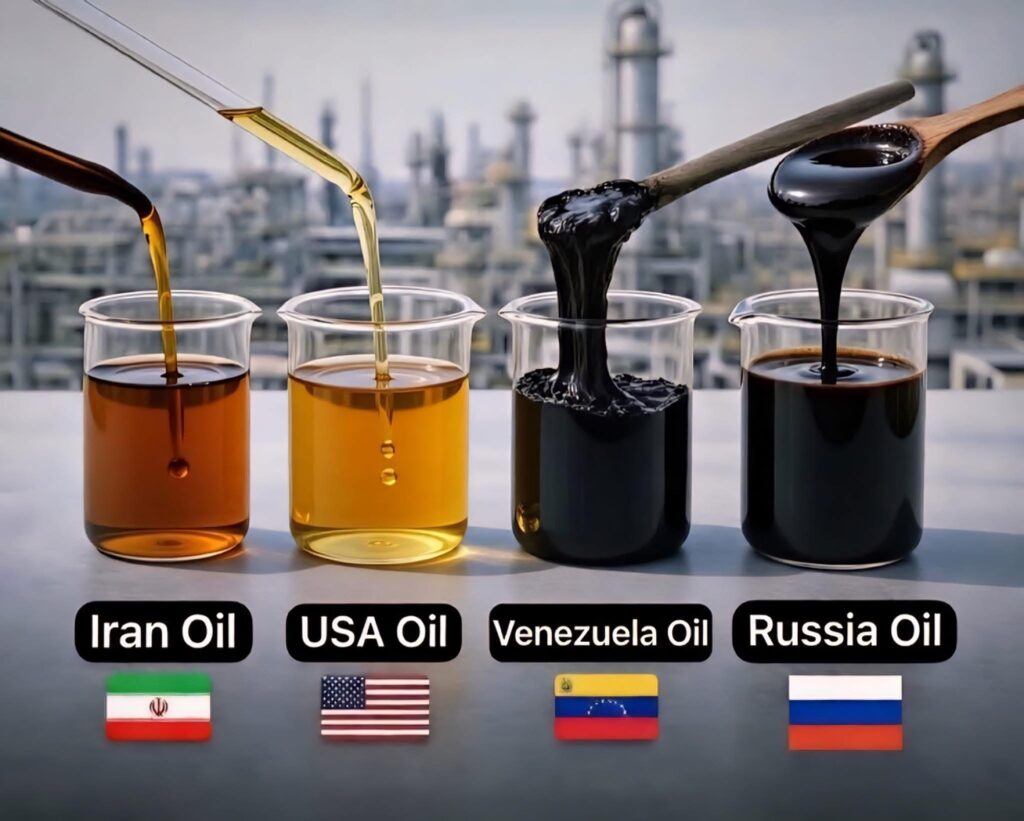
Refineries are not “one size fits all.” They are multi-billion dollar chemical cathedrals tuned to specific “diets.”
• The US Advantage (WTI): At 39–41° API, West Texas Intermediate is the “champagne” of crude. It yields a high percentage of gasoline and jet fuel with minimal processing. However, a refinery built for WTI cannot suddenly switch to Venezuelan sludge without catastrophic mechanical failure.
• The Venezuelan Struggle: Merey and Orinoco (15–16° API) are essentially liquid asphalt. Refining this requires “complex” setups—coking units and hydrocrackers—to break those long, stubborn carbon chains into something usable.
The Iranian “Sweet Spot”
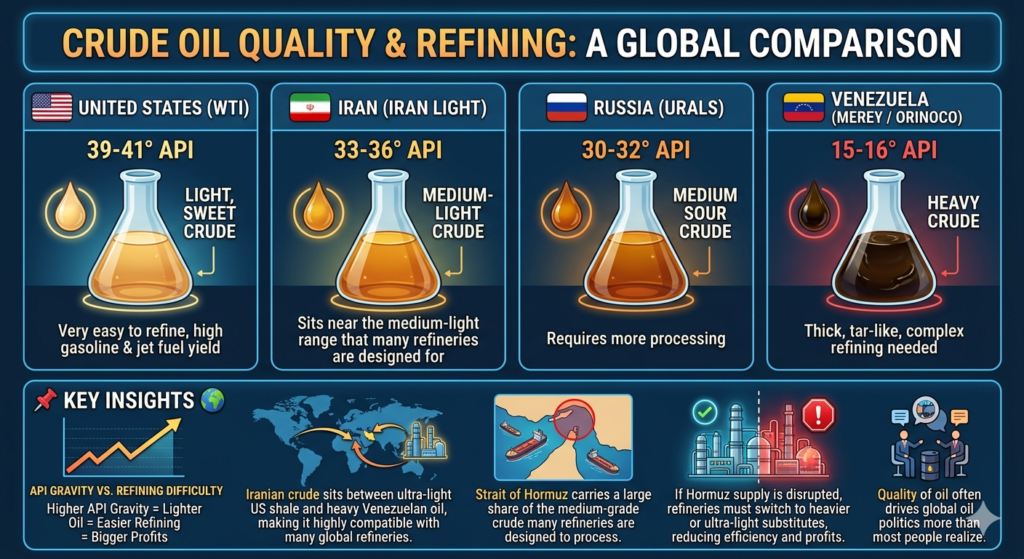
Iran Light (33–36° API) is the global industry’s “Goldilocks” grade. It isn’t as volatile as US shale, nor as difficult as Russian or Venezuelan crude.
• Global Compatibility: Most of the world’s aging refinery fleet in Europe and Asia was built to process medium-grade crudes. This makes Iranian oil exceptionally “plug-and-play.”
• The Hormuz Factor: Because the Strait of Hormuz is the primary artery for this specific medium-grade crude, a blockage doesn’t just raise prices—it creates a molecular mismatch. Refineries in India or China can’t simply replace Iran Light with US WTI without losing significant efficiency and profit margins.
Quality as a Political Weapon
The “Sour” in Russia’s Urals (30–32° API) refers to sulfur content. High sulfur is corrosive and requires expensive “desulfurization” to meet environmental standards. When global politics shift, the “quality” of a nation’s oil determines its leverage:
1. Discounting: Countries with sour or heavy oil (Russia/Venezuela) must often sell at a steep discount to convince refiners to deal with the extra “hassle” of processing it.
2. Sanction Resilience: Iran’s medium-grade oil is so vital to certain Asian refineries that finding a substitute is nearly impossible, giving Iran a “natural” shield against total market exclusion