
For many, turning 50 is a “golden” milestone, but in today’s economic climate, it’s also a high-stakes financial crossroads. With the global economy in 2026 grappling with the tail-end of persistent inflation and shifting tax laws like the SECURE 2.0 Act, the old “rules of thumb” are being rewritten. The core question isn’t just how much you have, but how that money will survive a 30-year retirement in a rapidly changing world.
The New Benchmark: The 6x to 8x Income Rule
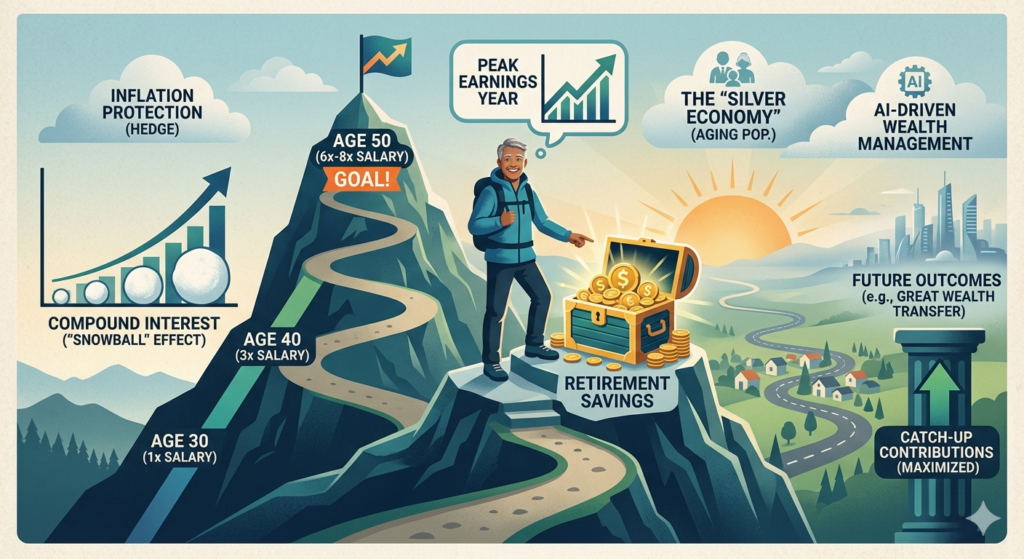
By age 50, the standard professional benchmark is to have six times your annual salary saved. However, as we move through 2026, many financial planners are nudging that goal toward eight times your income if you live in a high-cost urban area or lack a traditional pension.
• The Math: If you earn $100,000, your target is $600,000 to $800,000 in total retirement assets.
• The Rationale: This multiplier accounts for the Safe Withdrawal Rate (typically 4%), ensuring your lifestyle remains sustainable even if you stop working at 65.
Crucial Components: What Stays “Inside” the Topic
To truly assess your readiness, you must look beyond the balance in your 401(k). The following four elements are the most critical components of mid-life financial health:
1. Catch-up Contributions (The 2026 Shift): As of 2026, the rules for catch-up contributions have changed. For those aged 50–59, the catch-up limit for 401(k)s has risen to $8,000, while IRAs allow an extra $1,100. Crucially, if you earn over $145,000 (Social Security wages from the prior year), the IRS now requires these catch-ups to be made in a Roth (after-tax) account. This means you pay taxes now, but the growth is tax-free later—a vital hedge against future tax hikes.
2. Longevity Risk & Healthcare: With medical breakthroughs extending life expectancy, a 50-year-old in 2026 may realistically need their savings to last until age 95 or 100. This requires a strategy for Long-Term Care (LTC) and an understanding of how Medicare will factor into your budget.
3. The “Snowball” (Compound Interest): By 50, your contributions matter less than your market returns. At this stage, a 7% annual return on a $500,000 portfolio ($35,000) might exceed your actual annual savings. Managing your asset allocation to balance growth with protection is the “secret sauce” of this decade.
4. Debt-to-Income Liquidation: Entering your 50s with high-interest debt is a “retirement killer.” The goal by 50 is to have a clear path to being debt-free (including the mortgage) by the time you stop working.
Background Check: How We Got Here
The financial landscape of 2026 is a direct result of several “Black Swan” events:
• The 2008 Crash & 2020 Volatility: These taught 50-year-olds the danger of emotional selling. Those who stayed invested through these past events now hold the bulk of the market’s 20-year gains.
• The 2021-2024 Inflation Spike: This “Great Reset” devalued cash. It forced a transition away from “safe” 1% savings accounts into more aggressive, inflation-protected assets like I-Bonds and Real Estate.
Possible Future Outcomes: What’s Next?
Looking toward 2030 and beyond, several trends will dictate your success:
• The Great Wealth Transfer: An estimated $84 trillion is expected to pass from Boomers to Gen X and Millennials. For many 50-year-olds, an inheritance may suddenly close their “savings gap.”
• AI-Optimized Portfolios: The rise of AI in 2026 allows for hyper-personalized “tax-loss harvesting” and risk management, potentially squeezing 1–2% more efficiency out of your existing accounts.
• Social Security Adjustments: With the Social Security trust fund projected to face shortfalls in the mid-2030s, 50-year-olds must plan for the possibility of reduced benefits or a later “Full Retirement Age.”
The Bottom Line: If you aren’t at the 6x mark yet, don’t despair. Your 50s are your highest-earning years. By leveraging the new 2026 catch-up rules and tightening your budget now, you can perform a “financial U-turn” that secures your future in just one decade.