
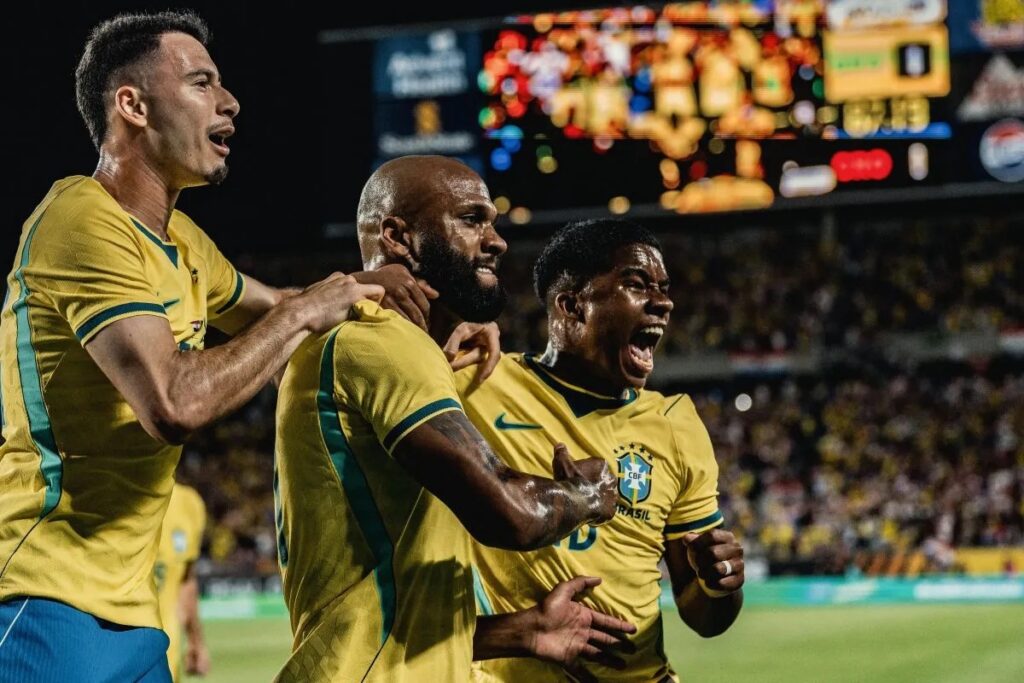
In modern football, managers are often judged by systems, substitutions, and marginal gains—but rarely does a match become an open laboratory. Yet on this peculiar night, Carlo Ancelotti turned what was meant to be a routine international friendly into something closer to a controlled football experiment, where two entirely different teams wore the same badge within 90 minutes. The result was not just a game; it was a split identity unfolding under stadium lights, as if two tactical philosophies had been stitched into a single timeline.
The premise itself was almost too unconventional to feel real. Under a rare pre-match agreement between the two nations, both coaching staffs approved an expanded substitution rule allowing up to 11 changes. Ancelotti, never shy of bending structure into opportunity, seized the moment with surgical precision. Instead of gradual rotations or late-game experimentation, he decided to split the match into two complete halves of identity. Ten substitutions at halftime meant that what began as one team would end as another—leaving only centre-back Léo Pereira as the lone constant across the full 90 minutes.
This was not experimentation for novelty’s sake. It was calculation. With World Cup selection looming, Ancelotti faced the familiar dilemma of modern elite managers: too many players, too few competitive minutes. Training sessions reveal patterns, but they never replicate pressure. Friendlies often drift into chaos with endless substitutions. But here, the structure itself became the experiment. Two distinct starting XIs would be exposed to identical opposition conditions, offering a rare comparative dataset under real match intensity.
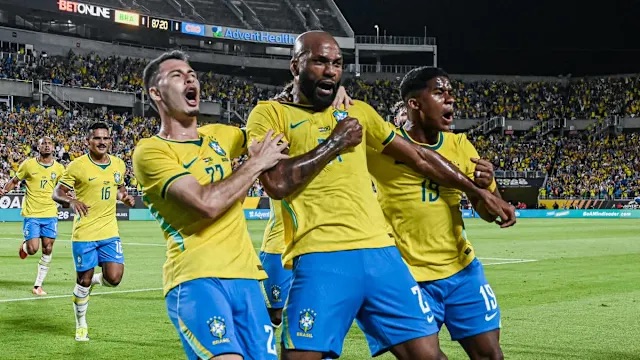
The first XI took the field with the energy of auditioners unaware they were part of a split narrative. Their approach was methodical, prioritising controlled possession and positional discipline. The midfield dictated tempo with cautious passing triangles, while the full-backs rarely ventured too far, as if aware that any structural imbalance could jeopardise their evaluation. There was ambition, but it was restrained—football played under the weight of selection uncertainty.
Tactically, the opening half reflected Ancelotti’s pragmatic patience. The pressing triggers were selective rather than aggressive, and transitions were managed rather than exploited. It was a team instructed not to win at all costs, but to survive scrutiny. Every player seemed to operate with invisible pressure, knowing that every touch was being weighed not just against the opponent, but against an unseen competitor waiting on the bench for the second half. The game was already split, even before the whistle for halftime arrived.
Then came the rupture. At halftime, ten players walked off not as substitutes in the traditional sense, but as a complete identity transfer. The stadium witnessed something closer to a relay race than a football match, except the baton was a national shirt. Only Léo Pereira remained, anchoring continuity in a sea of transformation. The second XI stepped in not as replacements, but as a parallel reality finally activated.
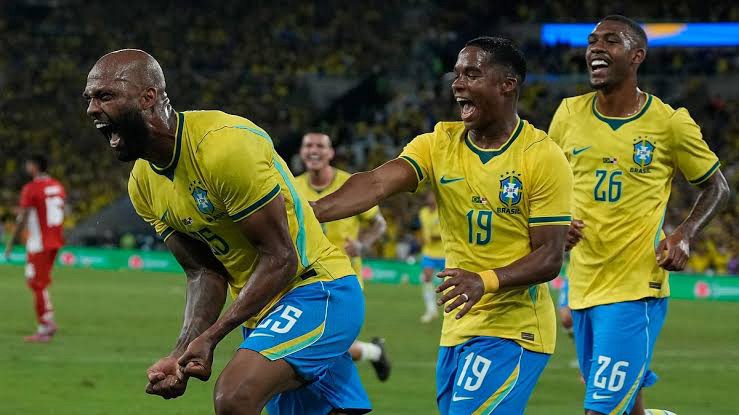
The new unit carried a different pulse entirely. Where the first group had been cautious, this one was expressive. Movements were sharper, risk tolerance higher, and vertical progression more immediate. The midfielders looked forward before they looked sideways. Wide players attacked space rather than preserving shape. Even the rhythm of passing changed—faster, more instinctive, less burdened by the fear of judgment. It was as if two tactical personalities had been tested under identical conditions, revealing stark contrasts in mentality as much as ability.
For analysts and coaching staff, the match became less about scoreline and more about decomposition. Which group handled pressing better? Which midfield structure sustained progression under fatigue? Which defenders adapted quicker to transitions? The unusual format stripped away the comfort of gradual substitution and replaced it with a binary comparison: two teams, one match, identical opponent, shared defensive anchor. Rarely does elite football offer such clarity in evaluation.
Beyond tactics, the implications for World Cup selection were profound. Ancelotti effectively compressed weeks of scouting into a single evening. Fringe players were no longer evaluated in isolation but in direct contrast to their positional counterparts from the other XI. The psychological dimension was equally revealing—who thrived under the knowledge of limited time, and who faded when structure changed around them. Selection, in this context, became less about talent alone and more about adaptability under segmented reality.
As the final whistle approached, the scoreboard felt almost irrelevant, a decorative detail on an otherwise experimental canvas. What mattered was the data extracted from lived minutes, the contrast between two footballing identities sharing one match. Ancelotti did not simply manage a team that night—he orchestrated a split-screen vision of possibility. And in doing so, he blurred the boundary between match and methodology, leaving behind a question more intriguing than any result: when a game becomes two auditions, what exactly are we really watching?