
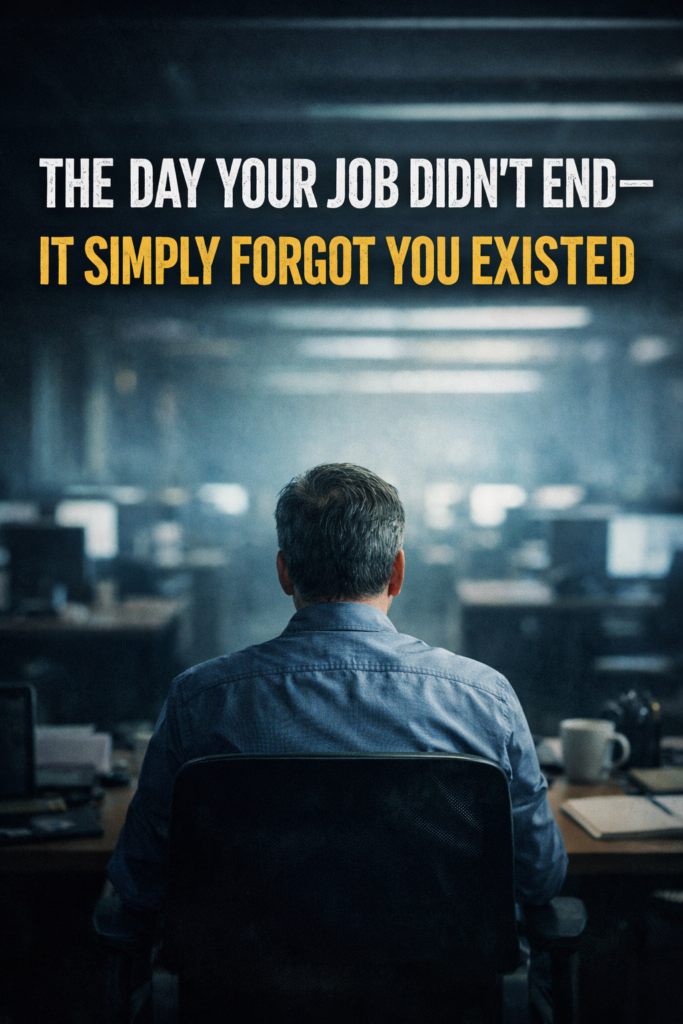
You don’t get fired anymore. Not really. There’s no meeting, no envelope, no final walk past familiar desks. Instead, something quieter happens. Your responsibilities shrink. Your decisions get second-guessed by systems you don’t see. One day, you realize your role hasn’t been taken—it’s been hollowed out. And no one announced it.
This is the era of the soft layoff. A phase where work doesn’t disappear overnight—it dissolves. Tasks you once owned become “automated suggestions.” Then “system-assisted workflows.” Then fully autonomous processes you’re only there to monitor, like a passenger pretending to drive.
At first, it feels like help. Fewer repetitive tasks, faster outputs, cleaner dashboards. You tell yourself this is progress. Everyone does. But slowly, the work that required judgment, instinct, and experience begins to fade. What remains is supervision—until even that starts to feel unnecessary.
There’s a strange psychological shift that follows. You’re still employed, still logging in, still attending meetings. But your contribution feels thinner, like a voice lowered in a conversation that no longer needs you. You begin to wonder: am I working, or am I just present?
Companies don’t call it replacement. They call it optimization. Efficiency. Scalability. And technically, they’re not wrong. Systems are improving outcomes, reducing errors, accelerating timelines. But beneath those metrics is a quieter truth: value is being redistributed, and not in favor of the human.
The unsettling part is how invisible it all is. There’s no headline for “gradual irrelevance.” No trending topic about roles that still exist but no longer matter. Because from the outside, everything looks stable. The job is still there. The title still exists. Only the substance has changed.
And then comes the moment most people don’t anticipate. Not a layoff—but a realization. You’re no longer learning. No longer challenged. No longer essential. Growth has stalled, not because you failed—but because the system no longer requires you to evolve with it.
This is where adaptation becomes survival. Not the kind we’ve known before—learning new tools, gaining new skills—but something deeper. The ability to stay ahead of systems designed to outpace you. To remain valuable in environments that are constantly redefining what value even means.
Because the future of work isn’t removing humans all at once. It’s reducing them gradually, strategically, almost politely. Until the transition feels natural. Until resistance feels unnecessary. Until absence feels like the logical next step.
And by the time most people recognize what’s happening, the shift won’t be coming. It will have already happened—quietly, efficiently, and without asking for permission.