
There are moments on American Idol that feel rehearsed, polished, expected. And then there are moments that arrive unannounced—quietly, almost gently—before leaving an entire room undone. Hannah Harper’s performance of “At The Cross (Love Ran Red)” belonged to the latter.
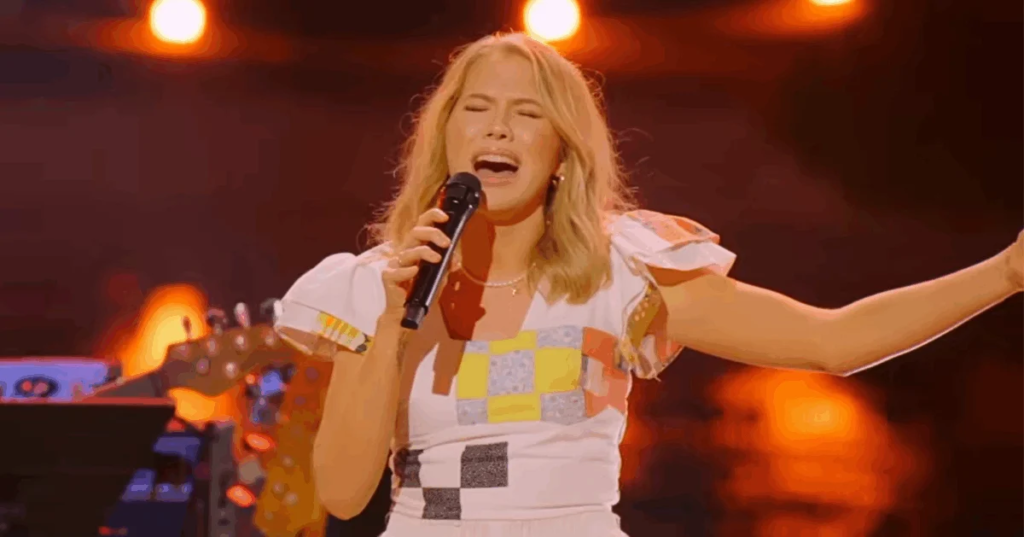
From the very first note, something felt different.
It wasn’t just a performance. It was a release.
Standing under the weight of the spotlight, Harper didn’t look like someone trying to win votes. She looked like someone surrendering to something far deeper than the competition itself. A mother of three, carrying not just her voice but her life into that moment, she let the song unfold through her—not around her.
And that distinction changed everything.
There was a visible stillness in the room. The kind that doesn’t come from anticipation, but from recognition. The audience wasn’t waiting for a big note or a dramatic finish. They were simply listening—intently, almost carefully—as if interrupting the moment would somehow break it.
Even the judges seemed caught off guard.
Carrie Underwood, who has seen countless performances shaped by faith and emotion, didn’t mask her reaction this time. Her expression said what words couldn’t fully capture. This wasn’t just admiration—it was connection.
Lionel Richie called it “spectacular,” but even that felt understated. Because what unfolded wasn’t about spectacle. It was about truth—delivered without hesitation, without protection.
And Luke Bryan’s word—“perfection”—didn’t refer to technique. It pointed to something far more fragile: authenticity in its purest form.
There’s a reason performances like this linger.
They don’t rely on flawless runs or vocal gymnastics. They live in the spaces between notes—in the breath that almost breaks, in the voice that chooses vulnerability over control. And Harper walked that line with a quiet bravery that’s impossible to manufacture.
For a brief moment, the competition disappeared.
There were no rankings, no voting windows, no strategies. Just a woman, a song, and a room that seemed to collectively lean closer, as if drawn by something invisible yet undeniable.
But reality, as it always does, returned.
Because American Idol is not just about moments—it’s about outcomes. And as the performance faded and the applause settled, a question began to rise beneath the surface of all that emotion.
Did the votes follow the feeling?
It’s a strange tension that defines shows like this. The most powerful performances are not always the safest ones. They ask something from the audience. They demand attention, reflection, sometimes even discomfort. And not everyone responds to that the same way.
Yet, Harper’s performance didn’t feel divisive.
It felt unifying.
Across social media, viewers echoed the same sentiment—not about perfection, but about presence. About how rare it is to see someone stand so openly in their truth, especially on a stage designed for competition.
And that’s where the conversation shifted.
Because maybe the real impact of that night wasn’t whether she advanced or not. Maybe it was the fact that, for a few minutes, she changed what people expected from the show itself.
She reminded them that music, at its core, isn’t about winning.
It’s about feeling.
Still, the question refuses to fade.
In a season filled with talent, momentum, and unpredictable turns, can a moment like this carry someone all the way? Or does its power exist precisely because it stands apart from the race?
There are no easy answers.
But one thing is certain.
Long after votes are counted and results are announced, this performance will remain—quietly, persistently—etched into the memory of everyone who witnessed it.
Not because it was the loudest.
Not because it was the biggest.
But because, in a competition built on being seen, Hannah Harper chose something far more difficult.
She allowed herself to be felt.