

There are songs that live comfortably in memory—and then there are songs that refuse to stay there.
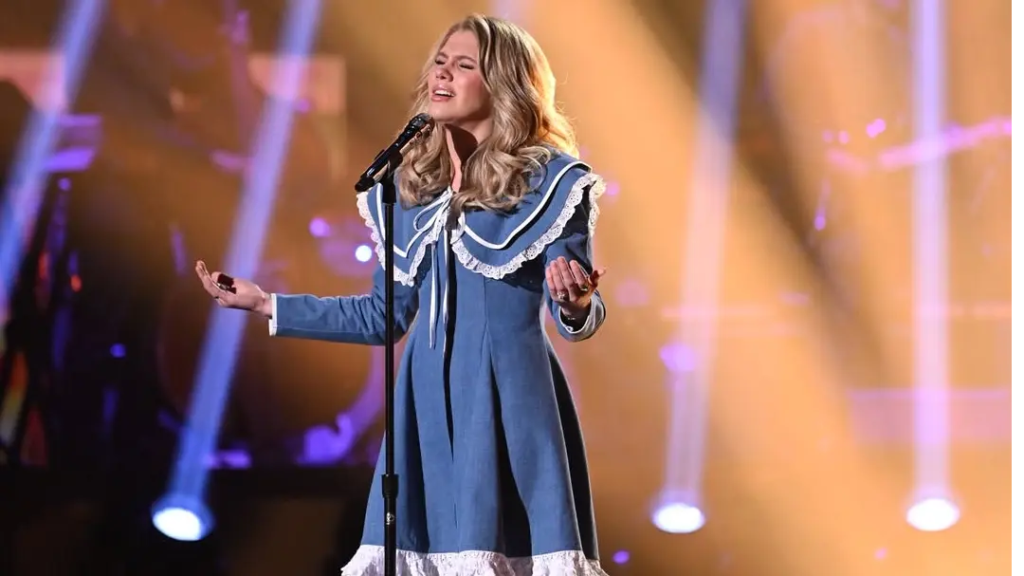
When Hannah Harper stepped onto the stage of American Idol to take on Heads Carolina, Tails California, it wasn’t just another cover. It was a risk. The kind of risk that doesn’t rely on volume or reinvention alone—but on the delicate balance between honoring something familiar and daring to make it feel new again.
And somehow, she found that balance.
The opening didn’t rush. It settled.
Instead of immediately reaching for energy, Harper leaned into control—letting the melody breathe before shaping it into something distinctly her own. There was a subtle shift in pacing, a slight edge in phrasing, a quiet confidence that suggested she wasn’t trying to recreate the original—she was trying to meet it.
On her own terms.
That’s where the transformation began.
Because “Heads Carolina, Tails California” isn’t just a song—it’s a moment in country music history. It carries a certain spirit: carefree, bold, rooted in storytelling that feels both spontaneous and timeless. To touch it is to step into a legacy.
And Harper didn’t step lightly.
She stepped honestly.
Her version didn’t chase nostalgia—it reshaped it. There was a sharper rhythm, a slightly faster pulse, but beneath that, something else lingered. A sense of grounding. As if she understood that the song’s power wasn’t just in its energy, but in its simplicity.
And she trusted that simplicity.
The audience responded in real time.
Not with shock, not with disbelief—but with recognition. They knew the song. They knew its history. But what they were hearing didn’t feel like a replay. It felt like a continuation.
And that’s rare.
Because covers often fall into two extremes—either too close to the original to matter, or too far removed to feel connected. Harper found the space in between. The space where respect meets individuality.
And then something unexpected happened.
Jo Dee Messina noticed.
Not as a distant observer, but as the voice behind the very song Harper had just stepped into. And when the origin of a piece acknowledges its reinterpretation, the moment carries a different kind of weight.
It becomes more than performance.
It becomes conversation.
Messina’s reaction didn’t arrive as noise. It didn’t compete with the moment—it expanded it. Because when an artist sees their work reflected through someone else’s voice, what they’re really witnessing isn’t imitation.
It’s evolution.
And that’s where the moment grew.
Fans began to look again—not just at Harper’s performance, but at what it represented. A new voice stepping into a familiar space and being seen by the one who created it. Some heard celebration in that exchange. Others heard something more layered—a curiosity, a quiet evaluation of how the song had been carried forward.

But regardless of interpretation, one thing became clear.
This wasn’t just about a cover anymore.
It was about connection across time.
Harper didn’t just sing “Heads Carolina, Tails California.”
She entered into its story.
And maybe that’s why the performance lingered longer than expected. Not because it was louder. Not because it was bigger. But because it felt like a bridge—between past and present, between origin and reinterpretation, between an artist who defined a song and another who dared to rediscover it.
That kind of moment doesn’t happen often.
It requires more than talent.
It requires awareness.
And perhaps most importantly, it requires restraint—the understanding that not every song needs to be changed to be made new. Sometimes, it just needs to be felt differently.
Harper understood that.
And in doing so, she didn’t just catch attention.
She earned it.