
In a competition built on reinvention, where every week seems to demand a new version of the same artist, Harper chose something far more difficult—she chose to remain. Not stagnant, not repetitive, but rooted. And in a space that rewards spectacle, that decision felt almost rebellious.

Because transformation has become the expectation. Contestants are often praised for “stepping out of their comfort zone,” for reshaping their identity to prove versatility. But somewhere along the way, transformation stopped being growth and started becoming performance itself—a visible shift designed to impress rather than express.
Harper didn’t follow that script.
Instead of chasing contrast, she leaned into consistency. The tone of her voice, the emotional texture of her delivery, even the way she approached each lyric—it all carried a familiar thread. And rather than feeling predictable, it felt intentional. Like an artist who understood that evolution doesn’t always mean departure.
That’s what made it powerful.
Because staying the same, when done right, isn’t about limitation—it’s about clarity. It signals a deep understanding of who you are as an artist, and more importantly, who you are not. And that kind of self-awareness doesn’t just show up on stage; it shapes every choice behind it.
There’s a quiet confidence in refusing to over-transform. No desperation to prove range. No sudden genre shifts just to create a moment. Harper didn’t try to surprise the audience—she trusted that connection didn’t need surprise to exist.
And that trust paid off.
What audiences began to notice wasn’t a lack of change, but a refinement of identity. Each performance didn’t feel like a new version—it felt like a clearer one. The edges became sharper, the emotion more precise, the storytelling more grounded. It wasn’t about becoming someone else. It was about becoming more herself.
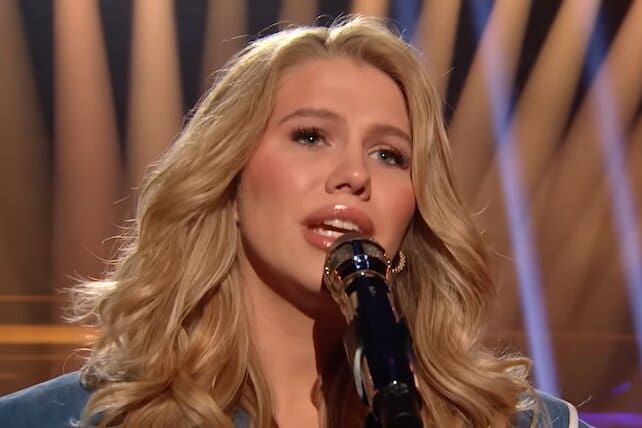
In many ways, that’s harder than transformation.
Because transformation can hide uncertainty. It allows artists to experiment, to try on different versions until something sticks. But staying the same requires conviction. It means standing in your identity without distraction, without disguise, and letting that be enough.
Harper made it enough.
There’s also something deeply human about consistency. Audiences don’t just connect with talent—they connect with familiarity. With patterns they recognize, emotions they can return to, a voice that feels like it belongs to a specific truth rather than a shifting performance.
That’s where loyalty is built.
And in a voting-driven competition, loyalty often outweighs spectacle. While others chase viral moments, Harper quietly builds something more durable—a relationship with the audience that isn’t dependent on surprise, but on trust.
It’s the difference between being remembered for a moment and being remembered, period.
Her refusal to over-transform didn’t limit her—it defined her. It carved out a space where her artistry could breathe without pressure to constantly reinvent itself. And in doing so, it made every performance feel less like a risk and more like a continuation of something real.
In the end, what Harper proves is something the industry often overlooks: not every artist needs to become someone new to be seen.
Sometimes, the most powerful thing you can do on a stage designed for change… is to stay exactly who you are.