
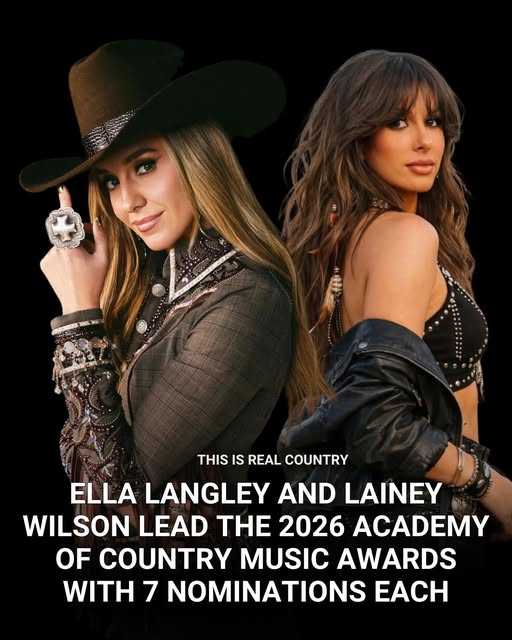
There are moments in music that feel like a shift—not loud, not sudden, but undeniable once you notice it. The 2026 Academy of Country Music Awards seem to be holding one of those moments, centered around two names that no longer feel like rising—they feel like arriving: Ella Langley and Lainey Wilson.
Seven nominations each.
On the surface, it reads like parity. A shared spotlight. But beneath that symmetry lies something more complex—two distinct voices, two different paths, meeting at the same point in time, shaping the direction of a genre that’s constantly negotiating its identity.
Because country music doesn’t just evolve through sound.
It evolves through feeling.
And both Langley and Wilson carry something that feels rooted, yet unconfined. Their music doesn’t attempt to redefine the genre in a disruptive way—it expands it quietly, allowing new textures to exist alongside tradition without forcing the two into conflict.
That balance is difficult to achieve.
But it’s exactly what makes this moment resonate.
Langley’s presence feels introspective. There’s a subtlety to her delivery, a sense that her songs are less about declaration and more about reflection. She doesn’t rush to be heard—she lets listeners come to her. And when they do, they find something layered, something that unfolds over time rather than revealing itself all at once.
Wilson, on the other hand, carries a different kind of energy.
Not louder—but more anchored. There’s a grounded confidence in the way she approaches her music, a clarity that comes from knowing exactly where she stands within the story she’s telling. Her voice doesn’t search for space—it occupies it.
And yet, despite these differences, they arrive at the same point.
Connection.
That’s what these nominations reflect more than anything else. Not just industry recognition, but audience alignment. The kind of response that doesn’t happen through visibility alone, but through resonance—when listeners don’t just hear a song, but recognize themselves inside it.

That’s why this moment feels significant beyond awards.
Because it isn’t just about who will win.
It’s about what their presence represents.
For years, conversations around country music have often centered on contrast—traditional versus modern, rooted versus experimental, familiar versus new. As if the genre needed to choose between what it was and what it could become.
But Langley and Wilson suggest something else entirely.
That it doesn’t have to choose.
That growth doesn’t require abandonment.
That new voices can emerge without erasing what came before them.
And perhaps that’s why their simultaneous rise feels less like coincidence and more like alignment. Two artists, each holding onto something authentic, each moving at their own pace, now standing side by side at a moment that feels larger than either of them individually.
There’s also something worth noting about timing.
These nominations aren’t arriving at the beginning of their journeys. They’re arriving after years of development—of writing, performing, refining, and quietly building something that didn’t demand attention but eventually earned it.
That kind of trajectory changes the weight of recognition.
Because it doesn’t feel like a breakthrough.
It feels like confirmation.
As the awards approach, the anticipation surrounding them isn’t built on speculation—it’s built on familiarity. Audiences already know what these artists bring. The question isn’t what they’re capable of.
It’s how far that capability will go.
And that’s a different kind of curiosity.
Not about potential—but about expansion.
Because when artists reach this point, something shifts. The spotlight doesn’t just follow them—it stays. Expectations don’t just rise—they settle into something more constant.
And how they move within that space begins to define what comes next.
For Langley and Wilson, this moment isn’t the culmination of something.
It’s the beginning of something else.
A phase where recognition meets responsibility. Where visibility meets influence. Where their voices begin to shape not just songs—but direction.
And maybe that’s what makes this moment feel so quietly powerful.
Not because it announces a new era.
But because it reveals one already in motion.