

Every competition season creates narratives. Some are earned, some are exaggerated, and some become labels contestants must fight to remove. For Keyla Richardson, one of the louder criticisms suggested her strongest moments depended too heavily on background vocals. It was the kind of comment that can linger unfairly, reducing an artist’s work to a talking point. But on a recent performance night, Keyla answered in the only way that truly matters—with the microphone in hand and the spotlight fully on her.
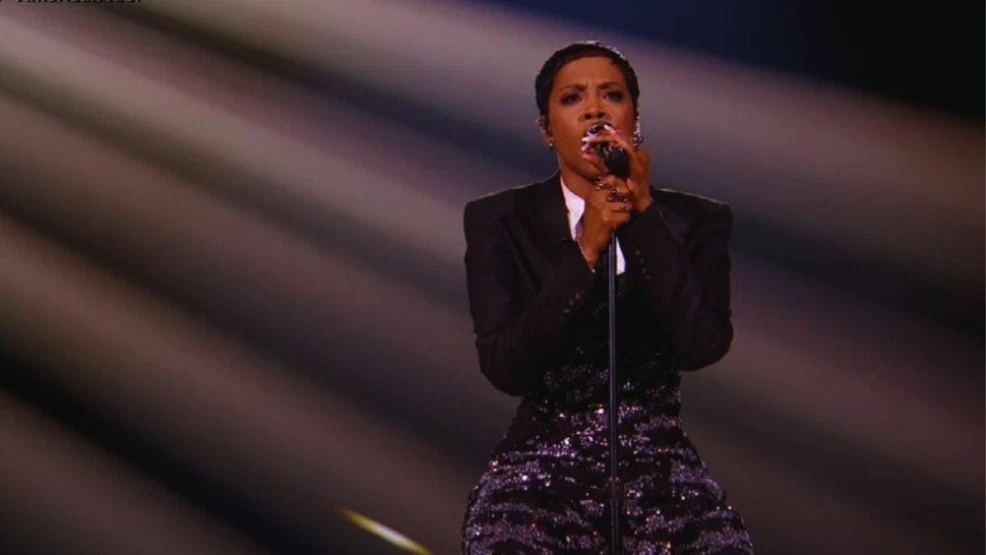
Her song choice was bold: Circle of Life from The Lion King. Few songs arrive with that level of expectation. It is iconic, emotionally grand, and vocally demanding. To choose it while carrying criticism about vocal independence was not a defensive move—it was a challenge thrown directly at doubt itself.
From the opening moments, it became clear this would not be a cautious performance. Keyla stepped into the song with presence and authority, refusing to shrink under the weight of expectations. There was no sense of hesitation, no attempt to play safe. She looked like someone determined to reclaim the conversation.
What stood out immediately was the voice itself. Stripped of the narrative surrounding her, listeners were left with what should have been obvious all along: range, power, control, and emotional intelligence. Her tone carried strength without becoming harsh, and her quieter moments showed restraint rather than dependence. This was not a singer being carried by production. This was a singer carrying the room.
That distinction matters. In televised competitions, viewers sometimes confuse arrangement choices with limitations. Background vocals, harmonies, and production layers are common tools used across all levels of music. They can enhance a performance, but they do not create talent where none exists. Keyla’s performance reminded everyone of that truth in real time.
As the song built, so did the atmosphere. Circle of Life demands scale, but scale without sincerity can feel hollow. Keyla avoided that trap beautifully. She brought both grandeur and grounded emotion, making the performance feel cinematic without losing the human center of it. Audiences were not just hearing a big number—they were watching a statement unfold.
And what a statement it was.
There was no hiding behind arrangement tricks, no overwhelming backing wall to blur the spotlight. Her voice remained the focal point, guiding every rise and fall of the performance. The confidence in that choice was almost as impressive as the execution itself. It said, without words: listen carefully now.
By the final chorus, the room seemed fully won over. The energy had shifted from curiosity to admiration. This is what happens when an artist meets criticism directly and turns it into fuel. Rather than reacting through interviews or excuses, Keyla responded through excellence. That is often the most effective kind of rebuttal.

The judges’ reactions reportedly reflected exactly that. Their praise felt less like routine compliments and more like recognition of a turning point. They understood what viewers were witnessing: not merely a good performance, but a redefinition. Those are different things. A strong performance entertains for a night. A redefining performance changes how the artist is perceived moving forward.
For Keyla, that shift could be crucial. In competitions, public perception can matter almost as much as raw ability. Once a narrative forms, contestants must work twice as hard to escape it. One breakout moment can break the cycle. This performance had that energy—the kind that forces audiences to reconsider everything they thought they knew.
It also revealed something deeper about her artistry: resilience. Many talented contestants struggle when criticism becomes personal or repetitive. It can tighten performances and drain confidence. Keyla appeared to do the opposite. She seemed sharpened by the noise, stronger because of the challenge, more focused because people were doubting her.
That quality often separates short-term contenders from lasting artists. Careers in music are filled with scrutiny, assumptions, and premature judgments. The ability to absorb pressure and answer through performance is invaluable. If Keyla continues developing that muscle, she may be building more than a competition run—she may be building longevity.
Fans online quickly responded in kind, celebrating the performance as one of her strongest yet. Many pointed specifically to the irony of the moment: the very criticism meant to diminish her ended up setting the stage for one of her clearest triumphs. There is a certain poetic justice in that.
And perhaps that is why this moment resonated beyond one song. It reflected something universal. Many people know what it feels like to be misunderstood, underestimated, or boxed into a label that does not tell the full story. Watching someone rise above that with grace and undeniable talent can be deeply satisfying.
So when people say, “She can only sing with back vocals? This was her answer,” they are describing more than a clapback. They are describing an artist taking control of her own narrative.
Keyla Richardson did not just perform Circle of Life. She used it to remind everyone that the loudest opinions are not always the truest ones—and sometimes the strongest response is simply a voice powerful enough to make doubt disappear.