

Some performances entertain. Some impress. And then there are the rare few that seem to stop time itself. On Rock & Roll Hall of Fame Night, Hannah Harper delivered one of those unforgettable moments when she stepped onto the American Idol stage and sang “Landslide.” By the time the final note faded, the room no longer felt like a television set. It felt like something sacred had just happened.
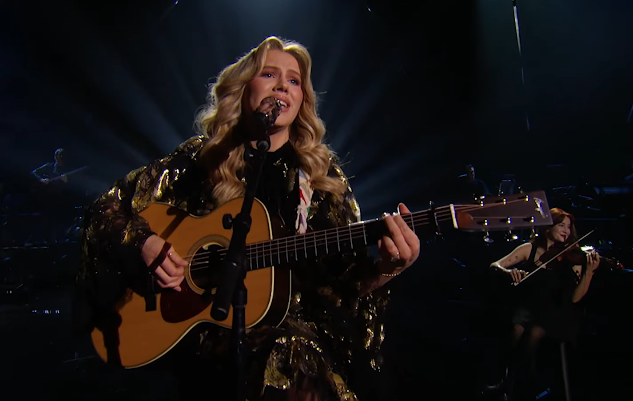
From the first lyric, there was a visible fragility in Hannah’s presence. Not weakness—honesty. Her voice carried a trembling emotional weight that instantly pulled the audience closer. She did not try to overpower the song or reinvent it with flashy runs. Instead, she trusted the simplicity of the lyrics and the vulnerability of the moment. That choice made every line land deeper.
“Landslide” is not an easy song to perform. It has history, emotional gravity, and the challenge of being so beloved that audiences already carry expectations into every note. Many contestants would treat it as a technical assignment. Hannah approached it like a confession. She sang as though every word belonged to her own story, and that authenticity transformed the performance into something deeply personal.
Then came the note everyone is talking about.
It was not merely high or technically precise. It was emotionally exact. The kind of note that arrives at the perfect second and says what language cannot. In that instant, the energy in the room changed. Carrie Underwood covered her face, visibly overwhelmed. Luke Bryan leaned toward the judges’ table and whispered something no microphone fully caught. The cameras moved on—but viewers noticed everything.
That unseen exchange has become almost as discussed as the performance itself. Audiences are replaying clips, reading lips, and speculating about what Luke said in that charged moment. Was it praise? Shock? A prediction? Whatever the words were, they appeared to carry weight. The judges’ expressions no longer resembled panelists evaluating a contestant. They looked like people witnessing someone cross into a new level.
Carrie Underwood’s reaction, especially, resonated with fans. Great performers recognize emotional truth when they see it. Her instinctive gesture—covering her face as tears threatened—felt genuine and immediate. It was not a made-for-TV response. It was the response of someone who understood exactly how difficult it is to move a room that deeply.
That is what separates memorable contestants from true contenders. Talent can be measured. Emotion cannot. Many singers hit notes. Fewer can make listeners feel exposed, nostalgic, hopeful, and heartbroken all at once. Hannah Harper managed to do that in a matter of minutes. The judges may score performances each week, but audiences remember moments—and this was one.
Social media reacted instantly. Fans began declaring Hannah a Top 3 lock before the episode had even ended. Comment sections filled with phrases like “winner energy,” “goosebumps,” and “this changed the season.” In an era where viewers move quickly from clip to clip, it takes something extraordinary to hold collective attention. Hannah did more than hold it—she commanded it.

What makes the performance even more powerful is the sense that it represented growth. Great competition shows are built on transformation. Audiences do not just vote for voices; they vote for journeys. Hannah’s rendition of “Landslide” felt like the moment a promising contestant became a serious artist in front of everyone watching.
And then there is the mystery of what happened after filming ended.
The broadcast captured reactions, applause, and the official judging moments—but many fans believe something meaningful happened once cameras stopped rolling. The body language, the emotion lingering onstage, the whispered exchange at the table—all of it has fueled theories that private words were shared, perhaps encouragement more personal than critique. Sometimes the most important moments in entertainment happen off-camera.
Whether or not those theories are true, they reveal something significant: people care. They are invested not just in Hannah’s vocals, but in her future. That kind of connection cannot be edited into existence. It must be earned through sincerity, and sincerity is exactly what Hannah brought to the stage.
There is also poetic symbolism in the choice of “Landslide.” The song has always been about change, reflection, and facing the person you are becoming. For Hannah Harper, it may have served as more than a cover. It may have been a statement. A quiet announcement that she is stepping into a bigger version of herself, even if she is still discovering what that looks like.
If the competition truly shifted that night, it happened because one contestant stopped trying to compete and started communicating. That is when artistry begins. The judges sensed it. The audience sensed it. Even the silence in the room seemed to understand it.
In the weeks ahead, stronger vocals may come. Bigger stage productions may arrive. But some performances cannot be topped because they tap into something deeper than spectacle. Hannah Harper’s “Landslide” moment may be remembered not as the loudest performance of the season, but as the one that felt most real.
And if fans are right, Rock & Roll Hall of Fame Night was not just another episode.
It was the night the race quietly found its frontrunner.