

There are victories that glitter, and then there are victories that bleed. What happened to Jack Hughes during the Winter Olympics 2026 belonged to the latter—a moment where triumph didn’t erase pain, it carried it forward.
It wasn’t just the impact that stunned people. It was what followed. Blood on ice, a broken smile, and yet, a refusal to leave the narrative unfinished. That image didn’t feel like an interruption; it felt like a raw, unscripted chapter in a story that demanded to be remembered.
In sports, we are conditioned to celebrate perfection—clean goals, flawless finishes, highlight reels. But this was different. This was imperfect, uncomfortable, and deeply human. And perhaps that is why it stayed with people longer than any statistic ever could.

What made the moment powerful wasn’t the injury itself, but the quiet defiance that came with it. Pain didn’t pause the meaning of the moment; it intensified it. In that instant, the gold medal became more than an achievement—it became a cost paid in full.
Weeks later, when Hughes appeared at Yankee Stadium, the setting had changed, but the story had not. The crowd didn’t just see an athlete throwing a ceremonial pitch; they saw continuity—a narrative refusing to fade after the headlines.
The new smile wasn’t just dental work. It was reconstruction in the truest sense—not of teeth, but of identity. Because what had been broken publicly had now been rebuilt just as publicly, and that visibility gave it meaning far beyond aesthetics.
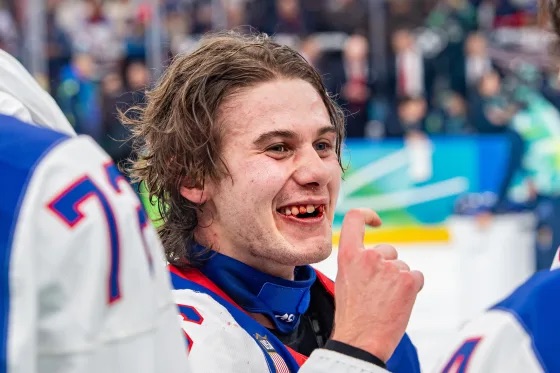
There’s something deeply compelling about recovery when it is witnessed. Private healing is powerful, but public healing becomes symbolic. Hughes didn’t just return; he returned carrying proof that resilience can be seen, not just felt.
In the world of the NHL, toughness is often measured in silence—in playing through pain without acknowledgment. But this moment shifted that idea. It showed that vulnerability, when visible, can be just as powerful as endurance.
What people connected with wasn’t the injury or even the comeback—it was the transformation. The realization that a single moment, however brutal, could reshape how an athlete is perceived forever. Not weaker, but more real.
And maybe that’s why the smile mattered so much. Because it wasn’t just about looking whole again. It was about proving that even when something breaks in front of the world, it can return—not erased, not forgotten—but redefined into something stronger than before.