

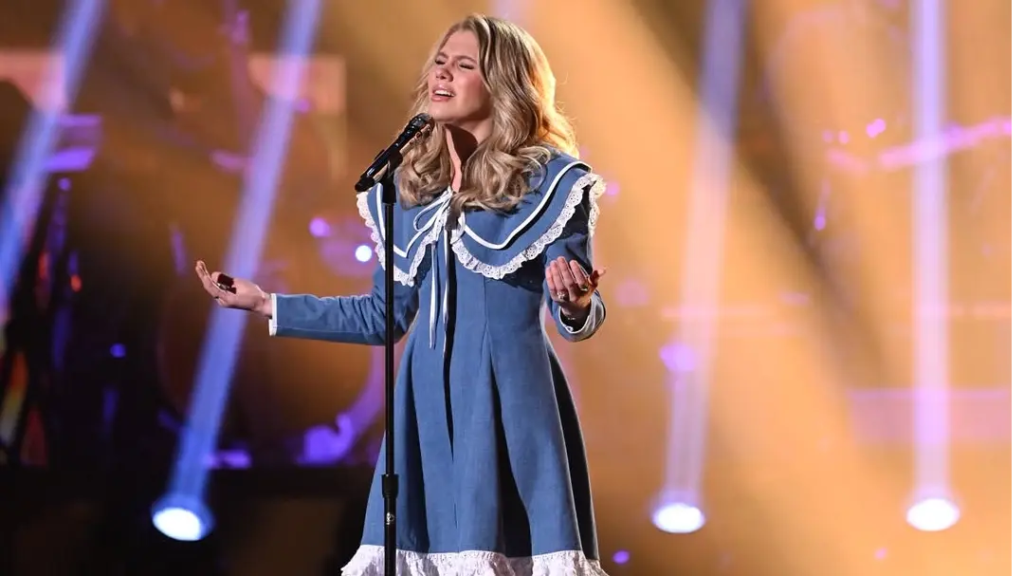
Some performances are praised, applauded, and quickly folded into the weekly cycle of competition television. Others arrive like a turning point. They stop the room, shift the narrative, and leave audiences speaking in a different tone afterward. Hannah Harper’s performance of “Landslide” was one of those moments. It did not merely dominate the night—it may have changed everything.

From the first note, there was a visible stillness in the room. The kind of silence that only happens when people sense something real is unfolding in front of them. Hannah did not attack the song with volume or theatrics. She approached it with restraint, patience, and emotional honesty. In a world where many singers try to prove themselves by doing more, she stood out by doing exactly what the song needed.
That choice is harder than it looks.
“Landslide” is one of those songs that can easily be overperformed. Its emotional weight tempts singers to dramatize every lyric, to push every phrase toward a climax. Hannah chose the opposite route. She trusted the words. She trusted the melody. Most importantly, she trusted the audience to meet her in the quiet places.
The result felt deeply personal.
Rather than sounding like someone covering a classic, Hannah sounded like someone living inside it. Every line carried reflection, vulnerability, and a sense of private truth. Viewers were not hearing a contestant sing a famous song. They were witnessing an artist interpret life through it. That distinction is what separates a good performance from a defining one.
What made the moment even more powerful was her control.
There was no overpushing, no unnecessary vocal gymnastics, no effort to turn the performance into a technical showcase. Hannah’s voice moved with discipline and sensitivity. She knew when to let notes breathe, when to pull emotion inward, and when to let the smallest inflection carry the biggest meaning. It takes maturity to understand that subtlety can land harder than spectacle.
The judges seemed to feel it in real time.
Carrie Underwood looked visibly emotional, as if fighting back tears while watching the performance unfold. That reaction mattered because great artists recognize emotional truth quickly. Carrie has lived through the pressures of televised competition and understands how rare it is for someone to command a room through sincerity alone. Her response suggested she knew this was more than another strong showing.
Then there was Luke Bryan.
Sometimes body language says more than commentary ever could. His reaction carried the unmistakable look of someone realizing, in the middle of a performance, that the stakes had changed. It was the expression people make when talent becomes undeniable. Not surprise exactly—recognition.
And recognition is everything in competitions like this.
Shows such as American Idol are built on progression. Contestants rise, stumble, recover, and grow. But every so often, one performance accelerates a contestant’s trajectory overnight. It becomes the reference point for the rest of the season. Future performances are compared to it. Other contestants are measured against its impact. Hannah’s “Landslide” felt like that kind of benchmark.
Fans noticed immediately.
Social media moved from admiration to certainty with unusual speed. Comments praising her emotional intelligence, vocal maturity, and star quality flooded timelines. More importantly, the conversation shifted from whether she is a contender to how far she can go. That is a major difference. Once viewers stop debating your potential and start predicting your finish, momentum has truly arrived.
And yes, many are already asking the obvious question: did she just lock in a Top 3 spot?
It is not an unreasonable theory.
Top placements are rarely secured by talent alone. They are built through memorable moments that create emotional investment. Audiences vote for people who make them feel something personal. Hannah’s performance did exactly that. It invited viewers into vulnerability rather than simply asking them to admire skill. That creates loyalty, and loyalty wins votes.
There is also strategic value in a moment like this.
Contestants who peak too early sometimes struggle later, but contestants who reveal new depth at the right time can become dangerous frontrunners. Hannah did not just remind viewers she can sing. She expanded her identity in the competition. She now looks less like a contestant trying to advance and more like an artist discovering herself in public.
That is compelling television.
For the remaining competitors, the challenge becomes sharper. They are no longer chasing only weekly praise. They are chasing a moment that felt authentic, elevated, and unforgettable. Those are difficult standards to match because they cannot be manufactured through bigger staging or louder vocals. Authenticity has to be felt.
What happens next matters.
One great performance can ignite momentum, but sustaining it requires growth. Hannah will now face rising expectations, closer scrutiny, and the pressure that comes with becoming a favorite. Yet if this performance revealed anything, it is that she appears comfortable carrying emotional weight. Some contestants shrink under bigger lights. Others become clearer in them.
She may be the second kind.
In the end, “Landslide” did more than showcase Hannah Harper’s voice. It revealed her instincts, discipline, and ability to create atmosphere with honesty instead of excess. Those qualities often outlast flashy moments and trend cycles. They are the qualities of artists who remain relevant long after competitions end.
So did Hannah Harper dominate the night?
Absolutely.
Did she change everything?
If the room’s silence, the judges’ faces, and the fans’ certainty are any indication, the answer may already be yes.