
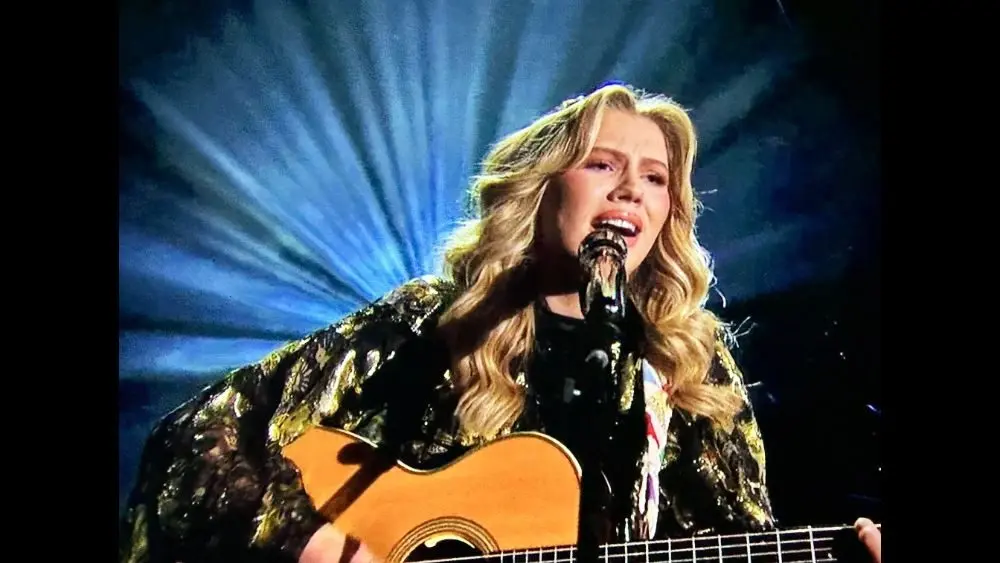
In televised singing competitions, there is an almost predictable formula for winning attention. Build the verse. Increase the tension. Pause dramatically. Then deliver the towering note that sends judges to their feet and social media into instant reaction mode. It is a familiar pattern because it works—at least temporarily. Big notes create obvious moments. They are easy to clip, easy to praise, and easy to remember. But Hannah Harper appeared to understand something many contestants miss: what is obvious is not always what is lasting.

That awareness allowed her to avoid one of the most common mistakes in high-pressure rounds—the “big note trap.” This trap happens when performers treat a song like a staircase leading to one explosive destination. Every lyric becomes setup. Every emotion becomes preparation. Everything exists to justify the peak. When the note lands, the moment may impress, but the rest of the performance can feel disposable.
Hannah seemed to reject that blueprint. Rather than turning songs into delivery systems for a vocal climax, she approached them as complete emotional journeys. The result was subtle but powerful. Audiences were not simply waiting for the moment. They were engaged in every moment. That shift changes everything because attention remains active from beginning to end.
There is nothing wrong with vocal peaks themselves. Extraordinary notes can be thrilling. They showcase skill, stamina, and confidence under pressure. But when contestants rely on them too heavily, performances can start to resemble each other. One singer belts here, another belts there, and the audience is left comparing volume, range, and duration rather than connection. Spectacle becomes currency, and individuality can get lost.
Hannah’s advantage was that she seemed more interested in storytelling than scoreboard metrics. She did not need every arrangement to announce difficulty. Instead, she often let phrasing, tone, restraint, and emotional timing carry the performance. That choice made her stand out in a field where many were trying to be the loudest voice in the room.
Psychologically, this is significant. Audiences often expect contestants to chase the big finish. They anticipate the note before it arrives. Once something becomes expected, its impact weakens. Surprise matters in entertainment. By refusing to lean on predictable peaks, Hannah created a different kind of suspense. Viewers no longer waited for one scream-worthy second—they leaned in to discover where she would take the song instead.
This strategy also suggests confidence. Contestants who depend on massive notes can sometimes appear to be proving themselves constantly. There is pressure in that approach: Watch how high I can go. Watch how long I can hold this. Watch how powerful I am. Hannah’s performances communicated a calmer message: Listen to what I’m saying. That distinction is subtle, but audiences feel it immediately.
When a singer trusts softness, they often gain credibility. A gentle phrase sung with conviction can feel more intimate than a shouted climax. A carefully controlled lower register can communicate maturity. A cracked edge of emotion can say more than pristine perfection. Hannah seemed willing to prioritize truth over theatrics, and that choice can build deeper loyalty than applause alone ever could.
Another reason avoiding the trap matters is longevity. Big notes are often remembered in the moment, but layered performances tend to grow in memory. People replay them to understand why they felt so moved. They notice new details on a second listen—the breath before a line, the slight pause, the choice not to oversing. Hannah’s performances likely benefited from this kind of rewatch value, where appreciation increases over time.
There is also strategic intelligence in preserving range and dynamics. If every week becomes a battle to top the last vocal peak, performers can trap themselves in escalation. Next round must be bigger. Then bigger again. Eventually the contest becomes less about artistry and more about surviving your own expectations. Hannah sidestepped that cycle by proving she could captivate without constantly raising the ceiling.
This does not mean she lacked power. In fact, restraint often makes power more potent when it finally appears. A singer who spends an entire performance at maximum intensity leaves little room for contrast. But a singer who understands pacing can make a moderate lift feel seismic. Hannah’s selective use of force likely gave her strongest moments extra impact because they were earned, not overused.

Judges and seasoned viewers tend to recognize this difference quickly. They know when someone is singing at a song versus living inside it. They know when technique is being displayed versus integrated. Hannah’s refusal to turn every song into a gymnastics routine likely signaled artistic maturity beyond her years or experience.
There is a broader lesson here about expectations themselves. Audiences often think they know what excellence should look like: louder, higher, harder, bigger. But the most compelling artists frequently rewrite those assumptions. They prove that control can beat chaos, nuance can beat noise, and sincerity can outlast spectacle. Hannah did not merely avoid the big note trap—she challenged the belief that it was necessary in the first place.
That is why her approach felt refreshing. While others may have reached for the ceiling, she reached for meaning. While others built toward one explosive second, she built complete performances. While others chased reaction, she cultivated resonance.
In the end, the strongest move was not hitting the biggest note in the room. It was making people forget they were waiting for one.