

There are songs so deeply woven into music history that most artists approach them with caution. They are beloved, emotionally loaded, and attached to memories millions of listeners refuse to let go of. Performing one of those songs can be risky. It invites comparison, skepticism, and enormous expectations. That is exactly why Hannah Harper taking on “Landslide” by Fleetwood Mac felt like such a bold choice.

Yet from the opening note, something unusual happened.
It did not feel like a contestant trying to survive a legendary song. It did not feel like someone carefully tracing the outline of a masterpiece, hoping not to disturb it. Instead, it felt personal. It felt lived in. Most importantly, it felt like hers.
That is an incredibly rare achievement in music.
Many performers can sing a classic well. They can match the melody, respect the arrangement, and deliver a technically polished version. But those performances often remain in the shadow of the original. They may be admired, yet rarely remembered. Hannah Harper seemed to understand that if she wanted the moment to matter, she could not simply recreate “Landslide.” She had to reveal something new inside it.
She began softly—controlled, measured, and almost conversational in tone. There was no rush to overpower the room. No dramatic opening designed to force applause. Instead, she trusted stillness. She trusted subtlety. In a performance world that often mistakes volume for impact, that kind of restraint can be more commanding than a shouted high note.
The softness mattered because it invited listeners closer.
When an artist sings gently with conviction, people lean in. They pay attention differently. They stop waiting for spectacle and start listening for meaning. That is what Hannah created from the start: attention built not through force, but through honesty.
Then, somewhere in the middle of the performance, the atmosphere changed.
What began as elegant and intimate became transformative. The song stopped sounding like a cherished classic being revisited and started sounding like a story being discovered all over again. The phrasing shifted. The emotional weight deepened. Certain lines seemed to land with fresh significance, as if she were uncovering truths hidden inside lyrics audiences had heard for years.
That is the difference between singing a song and producing a moment.
When someone said, “This song sounded like you produced it,” the compliment reached far beyond studio language. It meant the performance carried ownership. It meant Hannah Harper did not simply borrow the song for a few minutes—she reshaped the emotional experience of hearing it.
For any artist, that is one of the highest forms of praise.
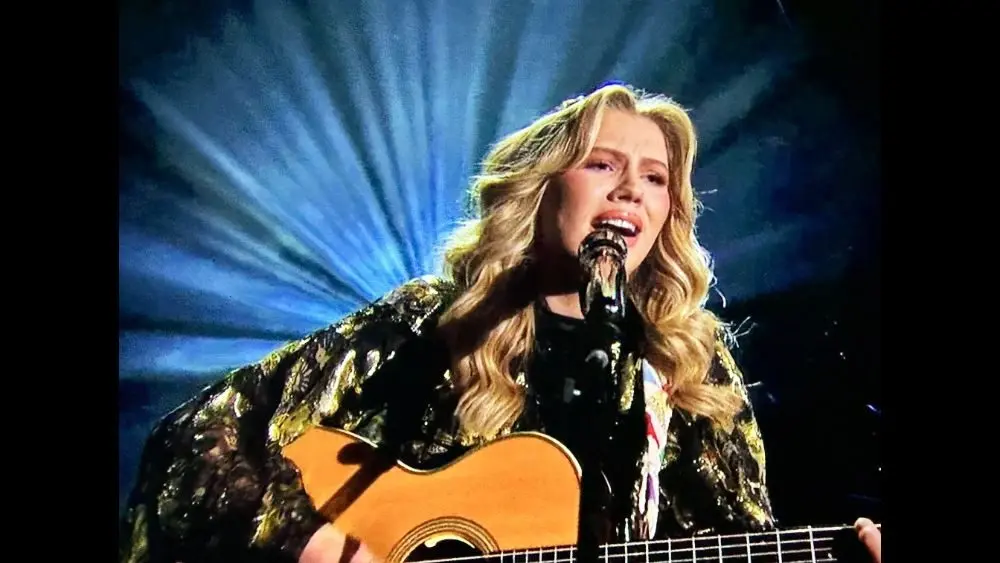
To make a classic feel brand new without disrespecting its roots requires remarkable instinct. Push too hard, and the song loses its identity. Stay too close to the original, and the performance disappears into comparison. Hannah seemed to find the narrow space in between: honoring the spirit of “Landslide” while allowing her own artistry to breathe through every line.
The judges clearly felt that balance.
As the performance continued, praise reportedly kept building. Reactions became stronger, more emotional, more certain. Those are the signs of a room realizing it is witnessing something larger than a routine television performance. Judges see talented singers constantly. What surprises them is authenticity that arrives with this level of command.
Then came the line that instantly changed the scale of the moment: “This might be the greatest performance of all time.”
Whether one takes that statement literally or emotionally, it reveals everything about the reaction in the room. Comments like that are rarely about statistics or rankings. They are expressions of impact. They happen when someone experiences a performance so fully that ordinary praise no longer feels large enough.
And perhaps that is why this moment resonates beyond a single episode.
Audiences do not remember every technically perfect performance. They remember the ones that moved them unexpectedly. The ones that made a familiar song feel personal again. The ones that seemed to pause time for a few minutes and remind people why music matters in the first place.
Hannah Harper’s version of “Landslide” appears to have done exactly that.
It also says something important about her future as an artist. Talent may get someone noticed, but identity is what sustains a career. When listeners begin saying a classic sounded like it belonged to the performer, it means the artist has something distinct. It means they are no longer just demonstrating ability—they are revealing perspective.
That is when careers start to become real.
For viewers at home, the performance likely felt emotional and intimate. For those in the room, it may have felt unforgettable. Great live moments often work that way: deeply personal to each listener, yet collectively powerful. Everyone receives something slightly different, but all leave knowing they witnessed something meaningful.
There will always be louder performances. There will be bigger vocal runs, more dramatic staging, and flashier attempts to dominate headlines. But volume fades quickly. Emotional truth lasts.
That is why moments like this stay.
Because Hannah Harper did not try to overpower a classic. She listened to it, entered it, and gave it back with her own fingerprints still on it. She made people hear an old song through new ears.
And when an artist can do that, they are no longer just covering music history.
They are beginning to write their own.