
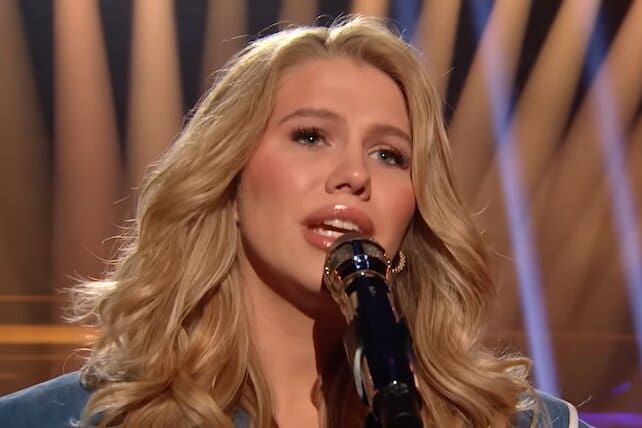
There are songs you perform. And then there are songs you approach with caution—almost like stepping into something already sacred. Landslide by Fleetwood Mac belongs to the latter.
It carries history. Memory. A kind of emotional imprint that doesn’t fade with time.

And that’s exactly what makes it dangerous.
Because when a contestant chooses a song like Landslide, they aren’t just singing—they’re entering a space already occupied by expectation. The audience doesn’t come in empty. They come in remembering. Comparing. Holding onto a version that already means something to them.
Most performances lose right there.
They either try to overpower the original—adding bigger notes, stronger runs, louder crescendos—or they play it too safe, blending into the shadow of what already exists. Both paths lead to the same place: forgettable.
But Hannah Harper didn’t choose either.
She chose restraint.
And that choice changed everything.
From the very first note, there was something noticeably different—not in what she added, but in what she refused to. No attempt to out-sing the legacy. No unnecessary vocal flourishes. No pressure to prove something bigger than the song itself.
Instead, she did something far more difficult.
She listened to it.
Not literally—but emotionally. She allowed the song to breathe instead of reshaping it. And in doing so, she created space—space for the audience to hear it again, not as a memory, but as a moment.
That’s where the performance shifted.
Because restraint, when done wrong, feels like hesitation. But when done right, it feels like control. And Hannah’s control wasn’t technical—it was emotional timing. She knew exactly when to hold back, when to lean in, and more importantly, when to let the silence carry the weight.
That silence mattered.
In a competition environment where contestants often compete for attention through volume and complexity, silence becomes almost uncomfortable. It demands focus. It forces the audience to stay present.
And Hannah used that discomfort as an advantage.
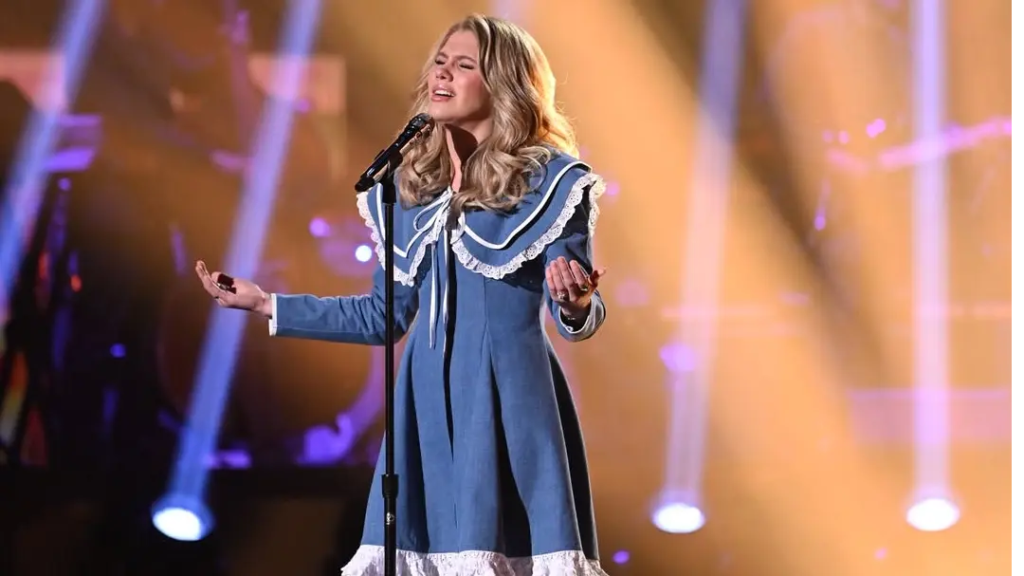
Instead of filling every second, she allowed pauses to exist. Not as gaps—but as extensions of the song itself. The result wasn’t just a performance—it was a recalibration of how the song was being experienced in that moment.
That’s rare.
Because most covers aim to reinterpret.
This one aimed to preserve—and in doing so, it transformed.
There’s a subtle difference between making a song your own and allowing a song to pass through you. The first is about identity. The second is about honesty. And Hannah leaned into the latter.
She didn’t try to redefine Landslide. She let it remain what it is—while gently shifting how it felt in the room.
And that’s where the risk paid off.
Because instead of inviting comparison, she quietly disarmed it. The audience stopped measuring her against the original. They stopped waiting for a moment to critique. Instead, they leaned in. They listened differently.
Not for perfection.
But for truth.
And truth, in performances like this, doesn’t come from how much you do—it comes from how much you understand what not to do.
That’s the paradox.
The less she added, the more it revealed.
The less she pushed, the more it connected.
And suddenly, a song that has been performed countless times didn’t feel worn. It felt intact. Almost untouched.
That’s what made it feel untouchable again.
Not because she elevated it beyond reach—but because she respected its weight enough not to compete with it.
In a stage of the competition where risk often comes in the form of doing more, Hannah Harper took a different kind of risk.
She did less.
And in doing so, she achieved something most performers don’t even attempt.
She didn’t try to own the song.
She let the song exist—and simply met it there.
And sometimes, that’s the most powerful choice a performer can make.