
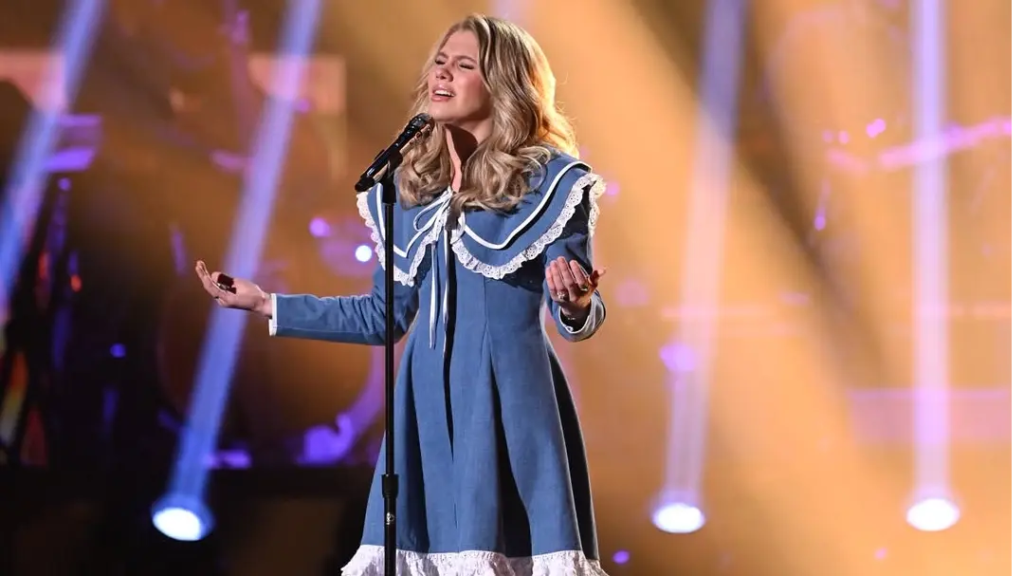
There are performances that entertain, and then there are performances that interrupt reality for a few minutes. The first kind earns applause. The second kind creates silence so complete that even breathing feels too loud. Hannah Harper delivered the second kind when she stepped onto the stage and sang “Landslide,” turning an ordinary competition night into something people would replay long after it ended.

What made the moment extraordinary was not excess. It was absence.
No vocal acrobatics designed to trend online. No dramatic screaming note placed for reaction shots. No desperate attempt to overpower the room with volume. In a night where many contestants believed bigger meant better, Hannah chose restraint. She became the quietest person in the room—and somehow the most impossible to ignore.
That decision was not safe. Quiet can disappear. Subtlety can be missed. Controlled performances can be overshadowed by louder personalities and bigger moments. On a televised stage built for spectacle, softness can be mistaken for weakness. Yet Hannah understood something many performers learn too late: when everyone is shouting, stillness becomes magnetic.
From the first phrase, the atmosphere shifted.
The audience did not explode with cheers. They froze into attention. Heads lifted. Conversations ended. The room seemed to narrow around her voice. It was the kind of collective stillness that only happens when people realize something genuine is unfolding in front of them. Not a gimmick. Not a trick. A moment.
She did not merely sing “Landslide.” She inhabited it.
Some contestants perform songs like assignments. They hit the notes, follow the arrangement, and move on. Hannah treated the lyrics like lived memory. Every line sounded discovered rather than recited. Every pause felt like thought. Every note carried emotion without forcing it. That distinction matters because audiences can hear the difference between performance and truth, even when they cannot explain it.
Her vocal control became one of the night’s most discussed elements, and for good reason. Control is often mistaken for technical neatness, but true control is emotional architecture. It means knowing when to pull back, when to hold tension, when to let fragility remain untouched. Hannah’s delivery felt effortless not because it was easy, but because mastery often hides its own difficulty.
That is why one fan described it as spell-like.
The comparison makes sense. Great performances create a temporary suspension of ordinary thought. People stop analyzing and start feeling. They forget the competition structure, the rankings, the weekly narratives, and the noise surrounding the show. For a brief stretch of time, there is only the song and the person brave enough to carry it honestly. Hannah created exactly that condition.
And in doing so, she changed how the other contestants looked.

This is not because anyone else failed. It is because contrast is powerful. When several performers lean into intensity, the person who chooses grace appears even more confident. When others push visibly, the one who seems effortless appears even stronger. Hannah’s calm precision made surrounding performances feel strained by comparison, not through criticism, but through clarity.
She exposed an important truth about competition stages: trying harder is not always the same as connecting deeper.
Many artists mistake visible effort for impact. They think audiences need to see struggle in order to appreciate success. But viewers are often moved most by those who make excellence look natural. Hannah’s performance carried that rare quality. Nothing looked forced. Nothing looked hunted. She appeared fully inside the song, and that serenity translated as power.
There is also something strategically brilliant about choosing a song like “Landslide” in a high-pressure round. It is a song people know intimately, which makes it dangerous. Familiar songs come with memory, expectation, and comparison. A weak version is exposed instantly. A strong version can feel borrowed. Hannah avoided both traps by making the song feel personal rather than famous.
That is difficult to do.
To take a beloved classic and return it sounding newly human requires more than talent. It requires perspective. It requires maturity. It requires the courage to trust nuance in an environment that rewards noise. Hannah showed all three.
The phrase “once-in-a-generation talent” gets used carelessly in entertainment. It is often attached to hype, youth, or temporary popularity. But when people use it after a performance like this, they usually mean something more specific. They mean a performer who understands that voice is not just sound—it is timing, instinct, emotional intelligence, and presence operating together.
Hannah Harper looked like that kind of performer.
Not because she sang the loudest note of the night.
Not because she dominated the stage with theatrics.
Not because she delivered the most obvious showstopper.
She looked like it because she trusted simplicity when simplicity was hardest to trust.
That may be why the moment lingers. Loud performances often win the instant. Quiet masterpieces tend to win memory. Days later, people may forget who shouted highest or moved fastest. But they remember the contestant who made a room fall still with nothing but control and truth.
Before the next round arrives with fresh headlines and louder moments, many viewers will return to this performance to understand what they felt the first time. They will replay the pauses, the phrasing, the calm confidence, and the sense that time briefly slowed around one voice.
Because Hannah Harper did more than sing that night.
She proved that sometimes the most powerful sound in the room is the one that never needed to raise itself at all.