
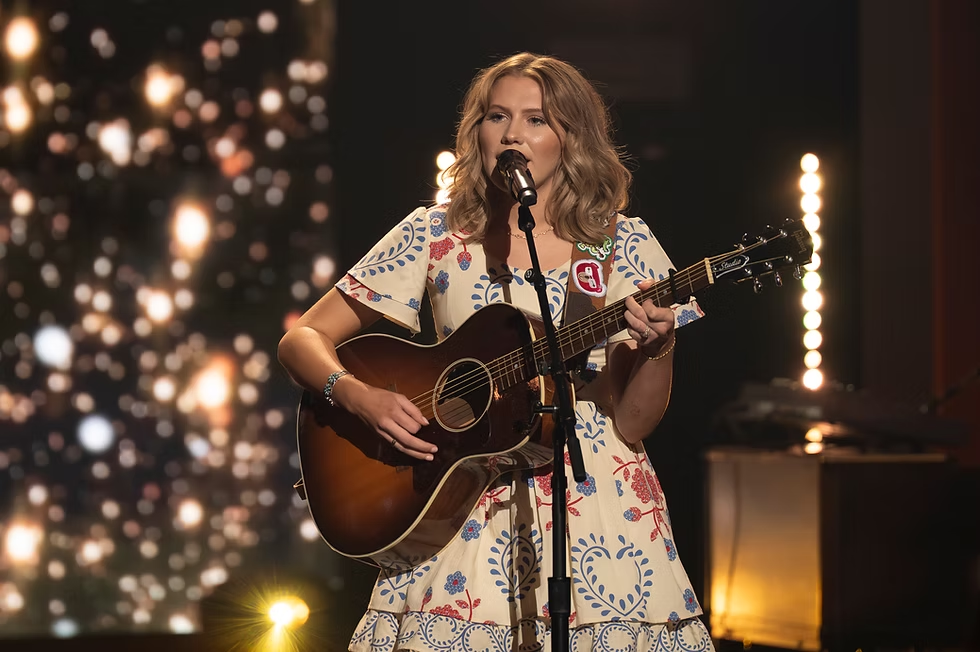
Some songs don’t age—they echo. Landslide is one of those rare compositions that seems to carry time inside it, rather than be defined by it. Written and originally performed by Fleetwood Mac, the song has always lived in a space between reflection and vulnerability. But what Hannah Harper did with it wasn’t just a cover—it was a quiet repositioning of its emotional center.

Because every generation hears “Landslide” differently. For some, it’s about looking back. For others, it’s about standing at the edge of change. And what Hannah understood—perhaps instinctively—was that the song doesn’t belong to one era. It belongs to a feeling that keeps renewing itself in different lives.
Instead of leaning into the weight of its legacy, she approached it with a kind of gentle detachment. Not in a way that dismissed its history, but in a way that freed it. She didn’t try to compete with the original voice behind it—Stevie Nicks—because that would have been a losing battle. Instead, she shifted the perspective entirely.
Where the original often feels like a retrospective—someone looking back on what has changed—Hannah’s version felt like someone standing right in the middle of that change. It wasn’t memory. It was immediacy. And that subtle shift altered everything.
Her delivery didn’t carry the same sense of weathered wisdom. It carried something more fragile, more uncertain. And that uncertainty is what made it resonate with a newer audience. Because today’s listeners aren’t always looking for answers—they’re looking for reflections of their own in-between moments.
There’s a strategic intelligence in that choice. In competitions like American Idol, song selection is rarely just about vocal fit. It’s about narrative alignment. And by choosing “Landslide,” Hannah didn’t just select a classic—she selected a story that could be rewritten through her own lens.
But what truly made the performance stand out wasn’t the song itself. It was the restraint within it. She didn’t oversing. She didn’t try to modernize it with unnecessary flourishes. Instead, she allowed space—space for the lyrics to breathe, space for the audience to project themselves into the performance.
That’s where generational reinterpretation becomes powerful. It’s not about changing the song. It’s about changing the angle from which it’s felt. Hannah didn’t update “Landslide” with sound—she updated it with perspective.
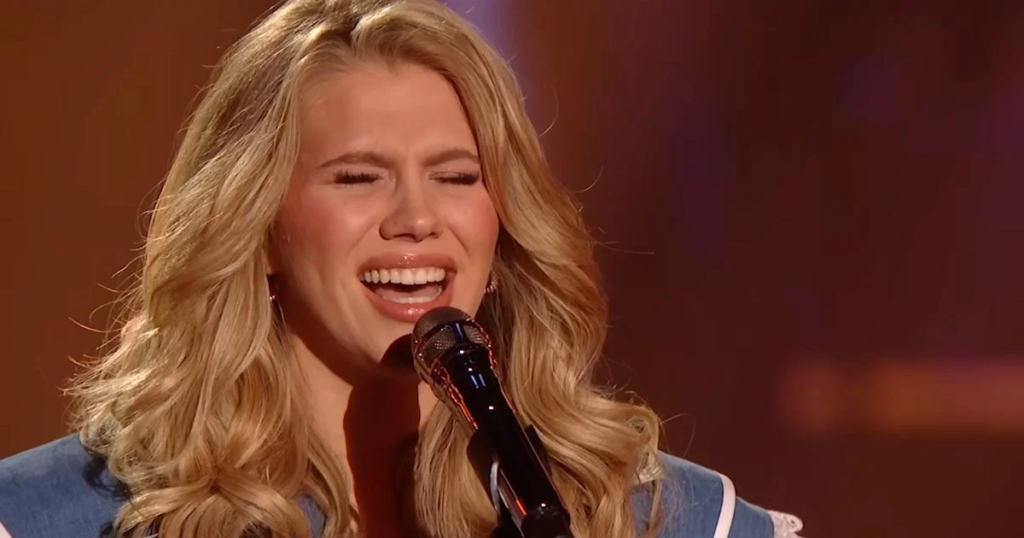
And in doing so, she created something rare: a version that didn’t replace the original, but existed alongside it. A parallel emotional experience. For older listeners, it may have felt like a return. For newer ones, it felt like a discovery.
This duality is what gives timeless songs their longevity. They survive not because they remain unchanged, but because they remain adaptable. Each artist who touches them adds a new layer, a new entry point for a different audience.
Hannah’s performance became one of those entry points. Not loud, not overly dramatic, but quietly transformative. The kind that doesn’t announce itself in the moment, but reveals its impact later—when people find themselves replaying it, not for the notes, but for the feeling it left behind.
And perhaps that’s the most remarkable part of all. She didn’t try to make “Landslide” bigger. She made it closer.