

There’s a quiet truth about shows like American Idol that rarely gets said out loud: judges don’t decide outcomes—memory does. Not the technical kind, not the note-by-note breakdown that gets dissected at the panel, but the emotional residue left behind when the performance is over. And somehow, in the chaos of a crowded stage, Hannah Harper didn’t just perform—she lingered.
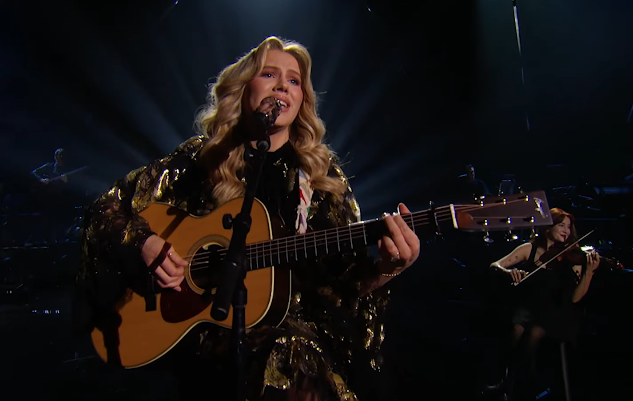
Judges critique in real time. They analyze pitch, control, range, transitions. Their job is precision. But audiences don’t live in precision. They live in recall. Hours after the episode ends, they aren’t replaying vocal runs in their heads—they’re remembering how something felt. That subtle ache, that unexpected stillness, that moment when everything went quiet without asking it to.
Hannah’s entry into the Top 9 wasn’t built on dominating the judges’ scorecards. It was built on quietly occupying the audience’s emotional space. While others chased perfection, she seemed to chase connection—and that difference is everything. Because perfection impresses, but connection stays.
There’s a psychological gap between critique and memory that most contestants never bridge. Judges operate in the present; audiences vote from the past. By the time voting opens, it’s no longer about what just happened—it’s about what remained. And Hannah’s performances have a way of remaining long after louder ones fade.
Think about it carefully. How many technically flawless performances do people forget within minutes? And how many imperfect but honest ones do they carry into the next day? Hannah exists in that second category. She doesn’t overwhelm you—she settles into you.
What makes this even more powerful is how understated her approach often is. In a competition where big notes are currency, she sometimes chooses restraint. And restraint, when done right, doesn’t disappear—it sharpens memory. It creates contrast. It forces the audience to lean in instead of being pushed back.
Judges might call that “safe.” But psychologically, it’s anything but. Because playing for memory is a long game. It means trusting that a quiet moment can outlast a loud one. It means understanding that people don’t always vote for the best singer—they vote for the one they can’t stop thinking about.

Hannah’s strength lies in her ability to create what can only be described as emotional anchors. Small moments—barely noticeable in real time—that grow larger in hindsight. A pause that felt longer than it was. A lyric delivered just slightly softer. A gaze that didn’t need theatrics to feel real.
And here’s where it becomes strategic: memory is cumulative. Each performance doesn’t just stand alone—it layers. So when viewers vote, they’re not just voting for one night. They’re voting for a feeling that has been building across multiple weeks. Hannah isn’t just competing in episodes—she’s building a narrative inside the audience’s mind.
Meanwhile, judge critiques reset every week. They are isolated evaluations. But audience memory? It compounds. And in a voting-based competition, compounded emotion will almost always outweigh isolated critique.
This is why someone can receive mixed feedback and still advance. Because judges are measuring moments, while audiences are measuring meaning. And meaning doesn’t always follow technical rules.
In the end, Hannah didn’t just make it into the Top 9 because she sang well. She made it because people remembered her when it mattered. Not the notes. Not the critiques. Just her.
And in a competition where thousands perform, but only a few are remembered… that might be the most powerful advantage of all.